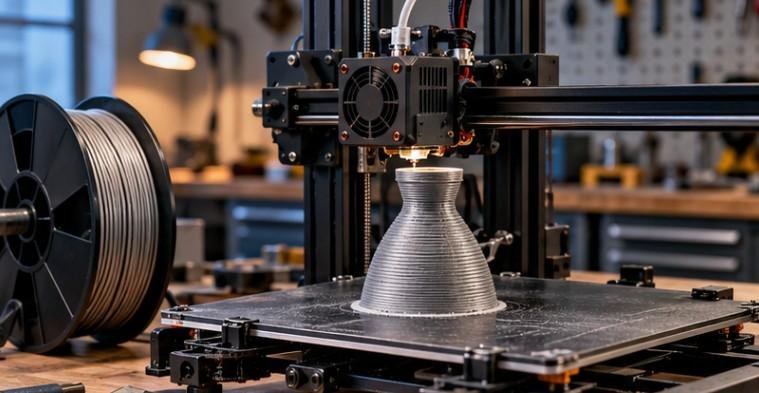
NASA has already hot-fire tested additively manufactured rocket nozzles for more than 1,000 cumulative seconds. The surprising part is not that metal printing works—it clearly does—but how different NASA’s process is from putting metal-filled filament through a desktop printer.
So, can you 3d print rocket engine nozzles out of metal at home? Technically, yes. A hobbyist can manufacture a metal object with the geometry of a rocket nozzle using accessible additive-manufacturing methods. Producing a nozzle that can reliably survive combustion pressure, extreme heat, thermal cycling, and flight loads is an entirely different problem. That distinction matters more than the printer itself.
What “3D Printing a Metal Nozzle at Home” Actually Means
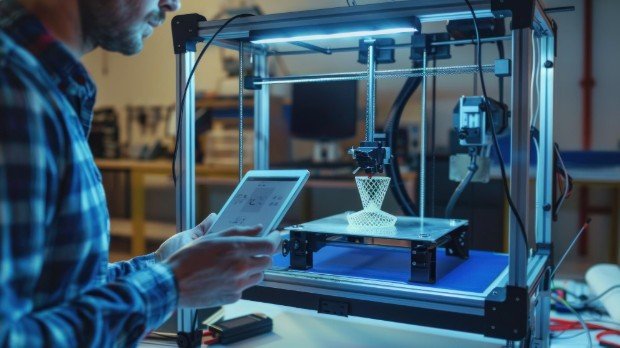
Most hobbyists do not own the laser powder-bed fusion or directed-energy-deposition machines used for aerospace hardware. Those systems require controlled atmospheres, specialized metal powders or wire, process monitoring, and extensive post-processing.
A more accessible route uses metal-filled filament. It contains a high percentage of metal powder suspended in a polymer binder.
The workflow broadly looks like this:
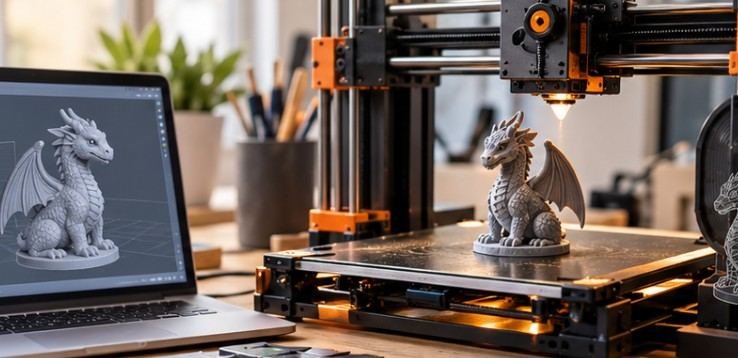
- A desktop FDM printer produces an oversized “green” component.
- The polymer binder is removed during controlled post-processing.
- The remaining metal structure is sintered so the particles bond together.
- The finished component is inspected and, where necessary, machined.
This is related conceptually to binder-based industrial metal manufacturing, although consumer feedstock extrusion and industrial binder jetting are not identical processes.
Penn State researchers describe metal binder-jet manufacturing as involving green-body production, debinding and post-processing, with sintering conditions playing a major role in final density and mechanical properties.
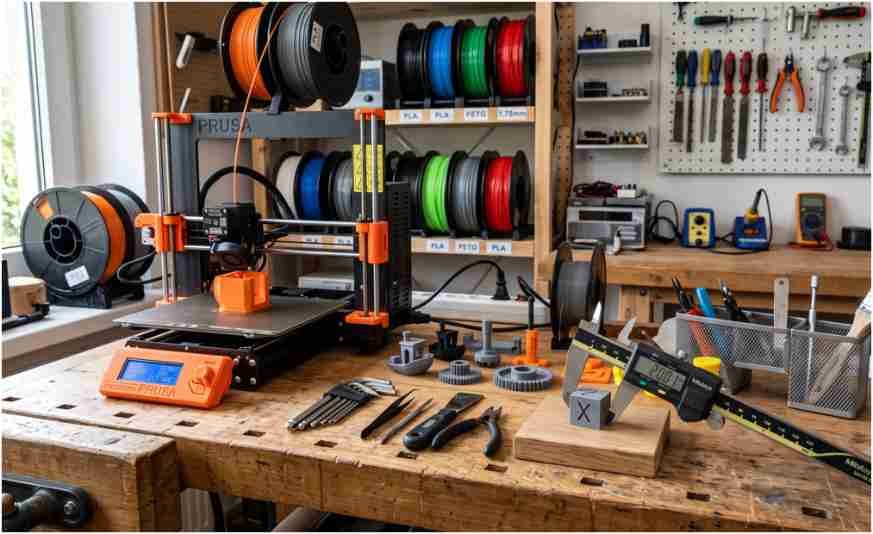
Anyone unfamiliar with desktop additive manufacturing should first understand the fundamentals of how to use a 3D printer before considering specialized composite or metal-filled materials.
Why Printing the Shape Is the Easy Part
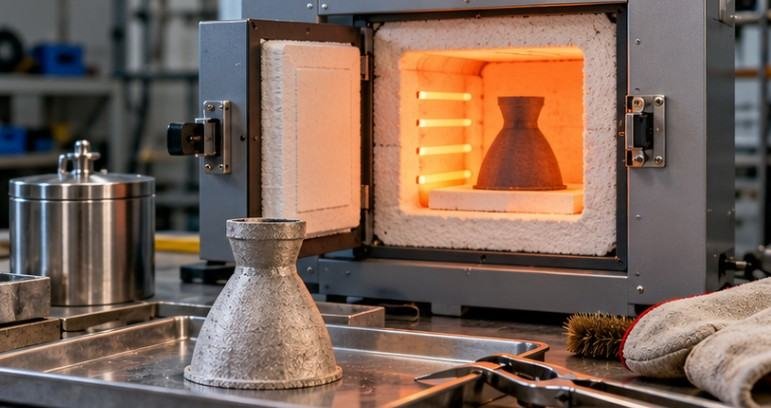
A rocket nozzle looks deceptively simple: a narrowing passage followed by an expanding bell or other exhaust geometry. Its working environment is anything but simple.
During operation, the nozzle must simultaneously cope with high gas temperatures, pressure loads, rapid heating, thermal expansion, vibration, erosion, and extreme temperature gradients through relatively thin walls. That is why professional rocket nozzles are engineering systems rather than merely metal shells.
NASA, for example, has developed additive processes specifically for producing nozzles with complex internal cooling passages. Some large-scale 3D-printed rocket nozzles Cryogenic propellant can circulate through those passages before entering the combustion process, carrying heat away from the nozzle wall.
Another NASA development used additive manufacturing to close high-pressure coolant channels around a thin nozzle liner. That hardware accumulated more than 1,040 seconds of hot-fire testing—a reminder that manufacturing the component is only the beginning of qualification.
Home Metal Printing vs. Aerospace Metal Printing
The practical differences are substantial.
| Factor | Hobby Metal-Filament Process | Aerospace Metal AM |
| Metal formation | Bound metal particles later sintered | Laser, electron beam, or directed-energy fusion/deposition |
| Dimensional control | Shrinkage must be compensated for | Closely controlled and measured |
| Density | Residual porosity may remain | Process optimized for very high density |
| Internal cooling | Extremely difficult to validate | Complex cooling channels routinely engineered |
| Inspection | Usually limited | CT, dimensional inspection, material testing and NDE |
| Qualification | Generally none | Hot-fire and structural testing |
This is why can you 3d print rocket engine nozzles out of metal at home has two legitimate answers: yes for making the physical component, but not automatically for making trustworthy propulsion hardware.
The Three Problems That Matter Most
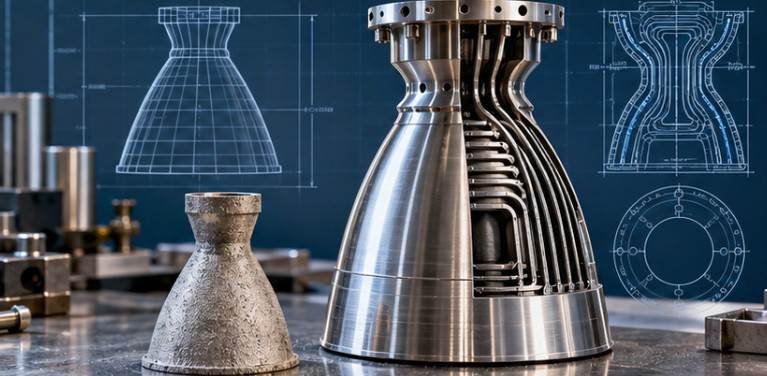
1. Shrinkage Can Change the Critical Geometry
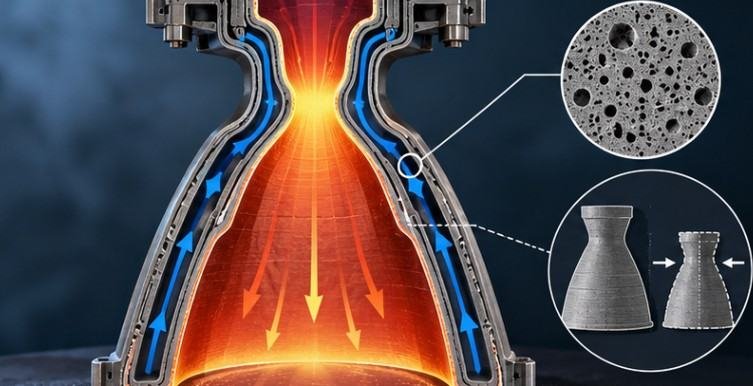
A bound-metal part changes size during debinding and sintering. Feedstock manufacturers compensate by scaling models, but final shrinkage depends on material, geometry, furnace conditions, orientation, and processing consistency.
That becomes particularly important around a nozzle throat, where small dimensional changes can significantly affect gas flow and engine behavior.
A part that visually resembles its CAD model therefore should not be treated as dimensionally correct without measurement.
2. Hidden Porosity Can Become a Failure Point
Even sophisticated porosity in metal additive manufacturing struggles with voids. The National Institute of Standards and Technology has studied porosity specifically because unwanted internal pores can contribute to premature failure in aerospace metal components.
That finding puts hobby manufacturing into perspective. Industrial manufacturers use carefully characterized processes, yet defects still require monitoring.
A home-produced component normally lacks X-ray computed tomography, metallurgical evaluation, calibrated process monitoring, and destructive material testing. The exterior can therefore look excellent while the internal structure remains uncertain.
3. Cooling Changes Everything
The most important misconception is that choosing a heat-resistant metal automatically produces a heat-resistant rocket nozzle. Material selection is only part of the problem.
Professional liquid rocket engines often use regenerative cooling, routing propellant through small channels around the combustion chamber and nozzle. NASA describes these channels as essential for preventing nozzle walls from overheating.
Those passages must remain properly formed, sealed, dimensionally accurate and capable of carrying pressurized fluid. Replicating their appearance is far easier than proving they will perform safely.
A Better Home-Shop Decision Test
Before deciding whether a metal nozzle is an appropriate 3D-printing project, ask what the finished object actually needs to do.
For a display model: desktop metal-filled printing can be genuinely useful. It can reproduce unusual bell shapes, aerospikes and educational cutaways while teaching metal-printing techniques.
For a machining prototype: printing may provide a useful geometry for checking fit, assembly clearances or manufacturing concepts.
For laboratory research: work through a university, qualified rocketry organization or properly equipped test facility where material characterization and safe test procedures are available.
For an operational rocket motor: appearance is not proof of suitability. Unknown density, shrinkage, thermal behavior and mechanical properties make unqualified parts a serious risk.
Dry, properly conditioned feedstock also matters when FDM is being used for prototypes; this guide to drying 3D printer filament explains why moisture control affects extrusion quality.
What Hobby Rocket Builders Should Know in the US
There is also a regulatory and safety distinction between ordinary model rocketry and experimental propulsion work.
The National Association of Rocketry says conventional model rocketry uses certified, commercially manufactured motors. Its Model Rocket Safety Code specifically says motors should not be tampered with or used outside manufacturer recommendations.
Experimental or high-power activities fall into a different category.
Tripoli Rocketry Association maintains specific rules for research motors, static testing, certification levels, motor materials and safe distances. Its code requires research testing to take place under controlled range procedures rather than treating experimental propulsion like an ordinary backyard project.
US flight operations can also fall under FAA amateur-rocketry rules. The FAA regulates amateur rockets through 14 CFR Part 101, Subpart C, with authorization requirements applying to certain operations.
So Is a Home-Printed Metal Rocket Nozzle Useful?
Absolutely—provided its purpose matches its capabilities.
A printed stainless-steel, bronze or similar nozzle can be a fascinating demonstration of additive manufacturing. It can reveal how sintering alters dimensions, how difficult smooth internal surfaces are to achieve, and why aerospace engineers spend so much effort on inspection and thermal management.
What it should not do is create false confidence. A shiny metal part coming out of a furnace does not carry information about hidden pores, material strength, coolant-channel integrity or performance under pressure.
FAQs
1. Can a normal 3D printer print real metal?
Not directly in the way an industrial laser system does. Some desktop printers can extrude metal-filled polymer feedstock that is later debound and sintered into a mostly or fully metallic component.
2. Can a 3D-printed metal nozzle survive rocket exhaust?
Professional printed nozzles can, but only after appropriate material selection, cooling design, controlled manufacturing, inspection and qualification. A home-sintered part should not be assumed capable of the same performance.
3. Why does NASA 3D print rocket nozzles?
Additive manufacturing can create complicated internal cooling passages and consolidated geometries while reducing manufacturing steps and lead times compared with some traditional methods.
4. Is experimenting with homemade rocket motors legal in the US?
Rules depend on the rocket, motor, location and operation. FAA regulations and recognized rocketry organizations impose requirements for various amateur and high-power activities.
The Real Answer Is in the Qualification, Not the Printer
The interesting answer to can you 3d print rocket engine nozzles out of metal at home is therefore yes—but printing is only the manufacturing step.
Modern aerospace nozzles succeed because their alloys, dimensions, internal cooling, material density and structural integrity are engineered and verified together. A home workshop can reproduce impressive geometry and even produce a genuine sintered-metal object, making this an excellent educational project. What it cannot easily reproduce is the inspection and qualification infrastructure behind flight hardware.
Treat the printed nozzle as a materials-engineering experiment first. That approach teaches far more—and avoids mistaking an aerospace-looking object for an aerospace-qualified component.