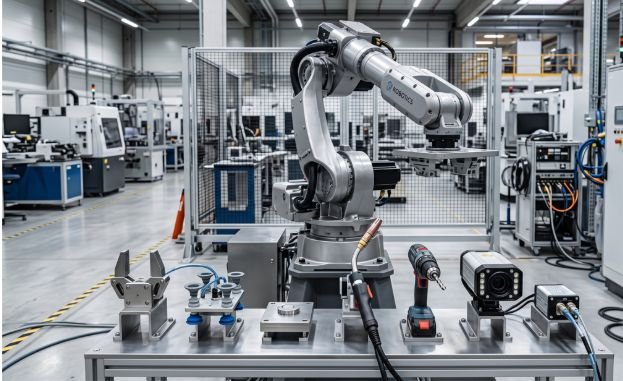
A robot arm can move with impressive speed and precision, yet it cannot perform useful work without the right wrist tool. The types of robot end effectors determine whether that arm can grip a carton, weld a frame, inspect a surface, or change tasks.
My practical rule is simple: choose the contact method first, then choose the power source. This approach prevents a common mistake—buying a fast gripper that cannot handle the actual product safely.
What Is a Robot End Effector?
A robot end effector is the device attached to a robot’s flange or wrist. It forms the working interface between the robot and its environment.
OSHA treats the end effector as part of the complete industrial robot system. Other system elements include controllers, sensors, power sources, programs, and communication interfaces.
Most types of robot end effectors fit into three practical groups: grippers, process tools, and sensing tools. Hybrid heads and automatic tool changers extend these groups by combining or swapping functions.
Gripping Types of Robot End Effectors
1. Mechanical Grippers
Mechanical grippers use fingers or jaws to clamp an object. Two-finger parallel grippers remain common because they are compact and relatively easy to program. Three-jaw designs center cylindrical parts more naturally.
Electric models provide adjustable force and position. Pneumatic units suit fast, repetitive work. Hydraulic grippers generate high force but require pumps, hoses, and additional maintenance.
I choose mechanical jaws when parts have predictable edges, sufficient stiffness, and a repeatable pickup position. Custom fingertips can improve surface contact and reduce slipping.
2. Adaptive and Soft Grippers
Adaptive grippers use flexible or underactuated fingers that wrap around changing shapes. Soft grippers deform around fragile products instead of forcing each item into one rigid jaw profile.
Research into robotic grippers highlights continuing tradeoffs between gripping force, dexterity, control complexity, and object protection.
These tools suit food handling, agriculture, mixed-item picking, and delicate packaging. Among the types of robot end effectors, soft grippers are especially valuable when product dimensions vary during one production run.
3. Vacuum and Suction Grippers
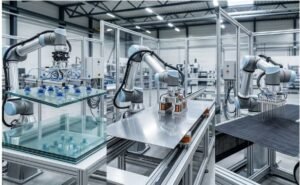
Vacuum grippers use suction cups connected to a vacuum source. They work well with glass, sheet metal, plastic panels, sealed packages, and smooth cardboard.
Porous, dusty, oily, or heavily curved surfaces may leak. Foam seals, larger cups, multiple suction zones, or another gripping method might be necessary.
Vacuum tooling can also weigh less than a complex finger system. However, the combined weight of the tool, camera, cables, and workpiece must remain within the robot’s payload rating.
4. Magnetic Grippers
Magnetic grippers handle ferromagnetic objects such as steel blanks, plates, machine parts, and scrap.
Permanent-magnet systems can retain a load during electrical power loss. Electromagnets provide fast release, but the cell requires suitable fail-safe controls.
Magnetic grippers will not handle aluminum, copper, wood, plastic, or many stainless-steel grades. Surface coatings, air gaps, material thickness, and residual magnetism can also affect performance. Magnetic tooling is widely used for manufacturing applications involving steel components.
I consider magnetics when steel parts contain holes, oil, or rough surfaces that make suction unreliable.
5. Ingressive Grippers
Ingressive grippers use pins, hooks, or needles that enter the material slightly. They can lift textiles, foam, insulation, carbon-fiber layers, and leather that leak too much air for standard suction.
Their limitation is surface damage. The puncture depth must be controlled carefully, and finished decorative surfaces may not tolerate this method.
6. Dexterous Multi-Finger Hands
Dexterous robot hands use several articulated fingers for complex grasping and in-hand repositioning. They can rotate or adjust an object without placing it back on a surface.
These systems offer flexibility, but they add weight, sensors, joints, programming demands, and maintenance costs. Researchers continue to develop new designs because matching the broad versatility of a human hand remains difficult.
For a fixed factory task, a simpler gripper usually performs faster. Dexterous hands make more sense in research, teleoperation, service robotics, and high-mix environments.
Process-Tool Types of Robot End Effectors
7. Welding Tools
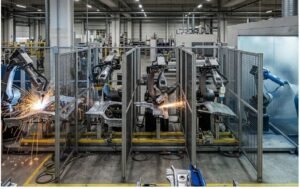
Robots can carry spot-welding guns, arc-welding torches, or laser welding heads. The programmed system controls position, angle, travel speed, and path consistency.
Automotive manufacturers rely heavily on welding robots because they can repeat hazardous and physically demanding motions. OSHA identifies welding as an established industrial robot function.
A complete welding package may include wire feeders, cooling lines, tip dressers, fume controls, and protective dress packs.
8. Material Removal Tools
Material removal end effectors include drills, routers, milling spindles, grinders, sanders, polishing heads, and deburring wheels.
These tools reshape parts or remove unwanted material. Cutting forces can deflect the robot, tool, fixture, or workpiece. Force-torque sensors and compliant mounts help maintain consistent pressure across uneven surfaces.
9. Dispensing, Spraying, and Fastening Tools
Dispensing heads apply paint, adhesive, sealant, grease, coatings, or other liquids. Precise flow control matters as much as the programmed robot path.
A robot may also carry screwdrivers, nut runners, riveters, and insertion tools. These types of robot end effectors turn the arm into a repeatable assembly station rather than a basic handling device.
Process monitoring can confirm whether the correct volume, torque, or fastening depth was achieved.
10. Thermal and High-Energy Cutters
Laser, plasma, and waterjet heads cut materials without a conventional rotating blade.
Selection depends on material composition, thickness, edge quality, heat effects, production speed, and operating cost. Each process also needs appropriate guarding, extraction, utilities, and cable protection.
The robot must move through its complete path without stretching, crushing, or twisting the tool connections.
Inspection and Sensor Types of Robot End Effectors
11. Probes and Metrology Scanners
Touch probes and metrology scanners inspect dimensions, hole positions, edges, gaps, and surface features.
A robot can move these tools across large structures that would be difficult to place inside fixed measuring equipment. However, results depend on robot calibration, probe repeatability, fixture stability, temperature, and approach direction.
Adding a probe does not automatically give every industrial robot coordinate-measuring-machine accuracy.
12. Vision and Force-Torque Sensors
End-of-arm cameras, 3D profilers, and force-torque sensors help robots locate parts, inspect surfaces, and control contact.
ATI produces six-axis force and torque sensors for robot arms and tooling. This feedback supports polishing, testing, assembly, insertion, and other contact-rich operations.
Vision systems can guide grippers toward products that arrive in changing positions. They can also check orientation, surface condition, labels, dimensions, or assembly completeness.
These sensor-based types of robot end effectors blur the line between a physical tool and a feedback system.
Hybrid EOAT and Automatic Tool Changers
Hybrid end-of-arm tooling combines several functions. One head might use suction for a carton and a mechanical clamp for a separator sheet. Another could grip a component, inspect it, and dispense adhesive without visiting a tool rack.
Automatic tool changers allow a robot to release one tool and lock onto another. ATI designs robotic tool changers for automatic end-effector switching while maintaining high repeatability over large numbers of cycles.
This flexibility comes with costs. The cell needs extra payload capacity, docking space, utility connections, control logic, and collision protection.
Automatic changers expand the types of robot end effectors one robot can use during a single production cycle.
How I Choose the Right End Effector
My selection sequence is object, task, contact method, failure mode, and then actuation.
Consider three parts. A sealed carton favors vacuum. An oily steel blank may favor magnetics. A delicate, irregular food product may require a soft adaptive gripper.
Starting with “electric or pneumatic?” skips the key question: how should the tool touch the product?
I also check payload, center of gravity, cycle time, contamination, washdown requirements, cable routing, maintenance access, and safe behavior during power loss.
The control strategy matters too. Predictable tasks may use simple commands, while force-sensitive work depends on sensor feedback. That distinction becomes clearer when comparing open loop vs closed loop robotics.
This contact-first method is my original selection lens for comparing the types of robot end effectors. Unsuitable contact physics cannot be corrected simply by adding faster actuators or more expensive software.
Pick the Tool, Not the Flashiest Gadget
The best end effector is rarely the most human-looking option. It is the lightest and simplest tool that handles the product safely while meeting the required cycle time.
I compare the types of robot end effectors by contact physics before comparing brands or prices. I also test the worst-case product rather than relying on a perfect sample.
That practical test exposes vacuum leaks, slipping, deformation, sensor blind spots, and clearance problems before the automation cell reaches production.
Frequently Asked Questions
1. What are the main types of robot end effectors?
The main groups are grippers, process tools, inspection sensors, hybrid tools, and automatic tool-changing systems.
2. Which robot end effector is most common?
Mechanical and vacuum grippers are widely used because they cover many industrial pick-and-place tasks.
3. What is the difference between a gripper and an end effector?
A gripper is one end-effector type; welders, cutters, dispensers, cameras, probes, and sensors are also end effectors.
4. How do I choose between pneumatic and electric grippers?
Choose pneumatic grippers for simple, fast cycles and electric models for adjustable force, position control, or changing product recipes.