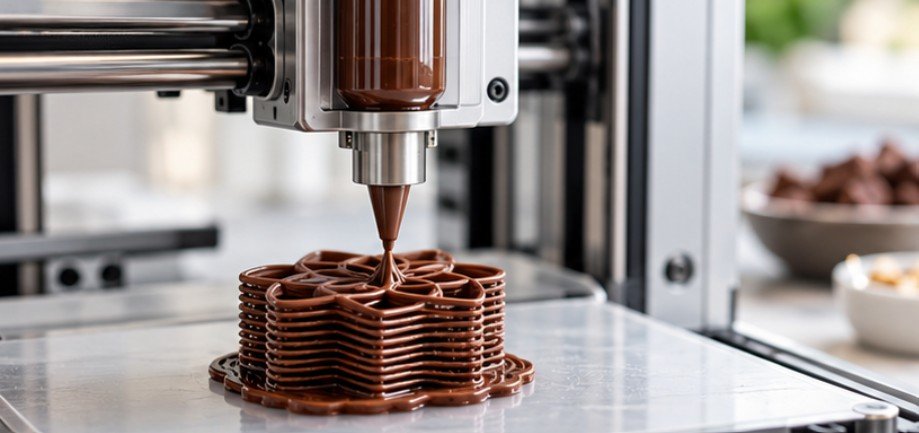
So, can 3d printers print food and how does it work? Yes. Instead of melting plastic filament, food printers dispense edible ingredients such as chocolate, dough, cheese, vegetable puree, frosting, or protein mixtures. Software directs the ingredients through a nozzle or other deposition system, building the food layer by layer.
A 3D printer can build a seven-ingredient cheesecake, shape vegetable puree into an appetizing meal, or deposit nutrients according to a digital recipe. Researchers are even experimenting with machines that use lasers to cook food after depositing it. The important distinction is that food printing is primarily a shaping and manufacturing technology. The printer does not magically manufacture ingredients from nothing.
What Exactly Is 3D-Printed Food?
3D food printing is a form of additive manufacturing. A digital model tells the machine where edible material should be placed, and the printer gradually constructs the final shape.
The USDA Agricultural Research Service describes the process as designing or scanning a food object digitally or 3D food printing, dividing that design into thin layers, and using computer-controlled robotics to build those layers from the bottom upward. Think of it less like a Star Trek replicator and more like an extremely precise pastry bag controlled by a computer.
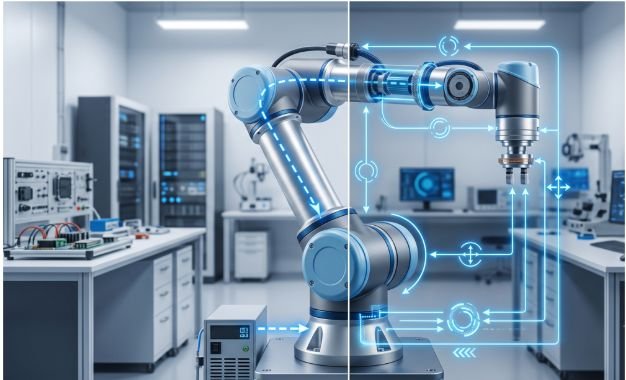
If you already understand how to design 3D print models, the digital workflow will sound familiar. A three-dimensional design is converted into instructions that tell the machine where, when, and how much material to deposit. The major difference is the material. Instead of PLA or PETG filament, the printer uses something edible.
How Does a 3D Food Printer Work?
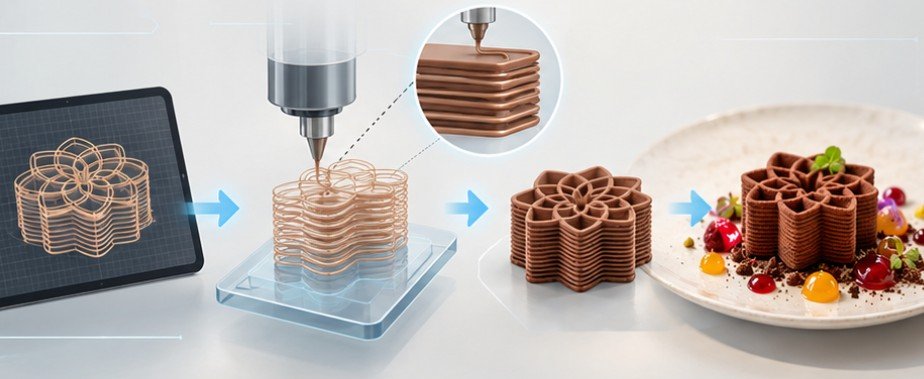
Most food printers follow five basic stages.
1. A Digital Food Design Is Created
The process begins with a digital model defining the food’s geometry. A designer might create a chocolate decoration, pasta shape, cookie structure, or precisely portioned meal. Software then converts the model into layers and movement instructions for the printer.
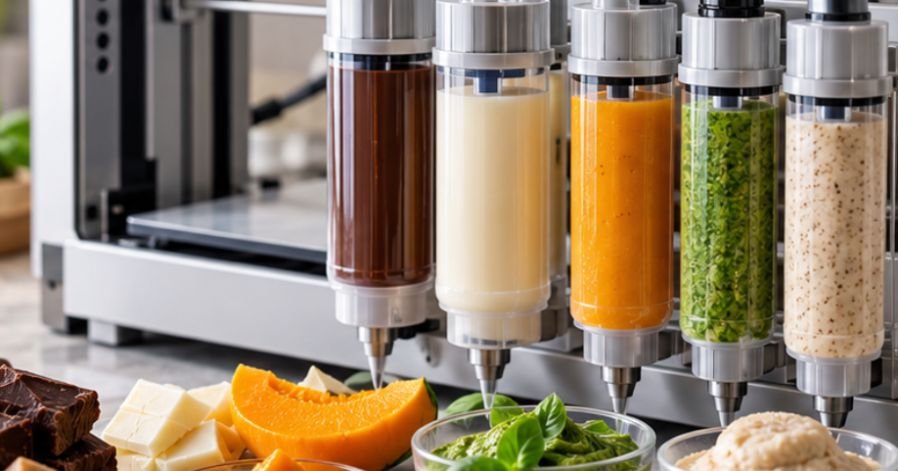
2. Ingredients Become “Food Ink”
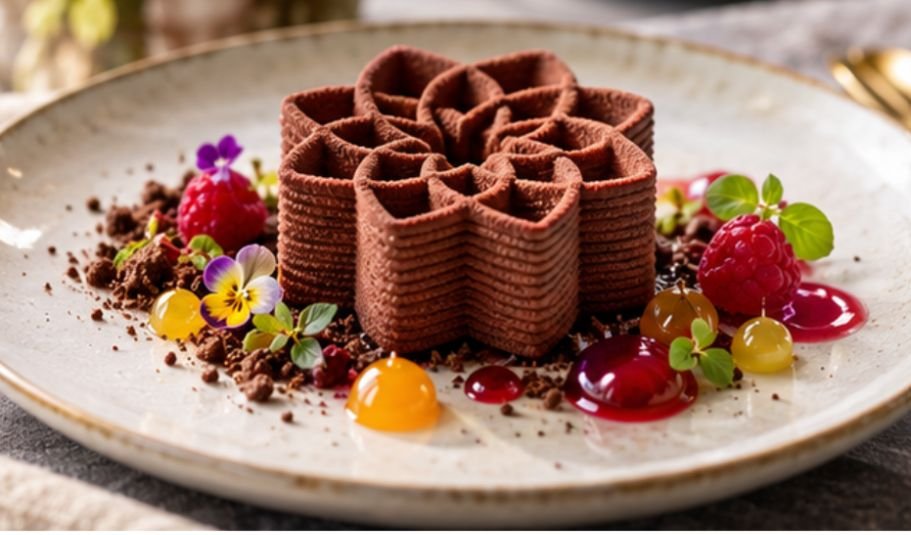
Ingredients must have the right consistency to move through the machine without collapsing afterward.
Common printable materials include:
- melted chocolate
- frosting
- dough
- mashed potatoes
- cheese
- nut butters
- fruit and vegetable purees
- protein pastes
Researchers commonly call these formulations food inks.
The challenge is rheology—the way a substance flows and deforms. An ingredient needs to flow through a nozzle under pressure but become stable enough to hold its shape immediately afterward.
Rutgers University researchers, for example, have experimented with chocolate formulations in which viscosity and ingredient ratios were adjusted specifically to achieve better printing behavior and mouthfeel.
3. The Printer Deposits Food Layer by Layer
Extrusion is currently the most recognizable food-printing method.
A motor, piston, compressed-air system, or screw mechanism pushes edible material through a nozzle. The print head moves along programmed X, Y, and Z coordinates while depositing thin strands.
Each new layer sits on the previous one until the complete object is formed. Extrusion dominates research because many everyday foods can be converted into printable pastes.
4. The Structure Must Support Itself
This is where food printing becomes unexpectedly similar to architecture. A tall structure made entirely from strawberry jam would slump. Softer ingredients therefore need stronger layers around or beneath them.
Columbia University engineers demonstrated the problem while producing a seven-ingredient printed cheesecake. Their successful designs used stronger ingredients as structural supports and softer ingredients inside protected areas.
Nozzle diameter, printing speed, temperature, ingredient viscosity, layer thickness, and extrusion rate can all change whether a print succeeds.
5. The Food May Still Need Cooking
One of the biggest misconceptions is that every food printer prints a finished hot meal. Most do not.
Chocolate, frosting, and some other ingredients may be edible immediately. Dough, meat mixtures, and similar foods generally require a separate baking, grilling, steaming, or heating step. Researchers are exploring an alternative: combining printing and cooking.
The U.S. National Science Foundation highlighted Columbia experiments in which food was deposited digitally and a laser was used to heat or brown selected areas. That could eventually give software control not only over shape but also over browning, texture, and cooking intensity.
Why Print Food Instead of Making It Normally?
Making a sandwich conventionally is obviously faster than printing one. The technology becomes more interesting when customization matters.
Personalized Nutrition
Because ingredients can be digitally portioned, future systems could adjust calories, protein, carbohydrates, vitamins, or other nutrients for individual needs.
NASA has investigated this idea for long-duration missions. One NASA-backed project proposed combining 3D printing for macronutrients and structure with inkjet systems dispensing micronutrients, flavor, and aroma.
That level of precision may eventually become valuable in healthcare, sports nutrition, elder care, and institutional food preparation.
Personalized food production also has implications beyond Earth, where resupply constraints make efficient resource use and tailored nutrition especially important.
Explore how 3D printing is changing space exploration to understand how additive manufacturing could support long-duration missions through on-demand production, material recycling, and reduced dependence on supplies transported from Earth.
Better Food for People With Swallowing Difficulties
Pureed meals are often necessary for people with dysphagia, but a shapeless scoop of puree may look far less appetizing than familiar food.
Printing can transform a texture-modified puree into recognizable forms while preserving a softer consistency.
This is more than decoration. Appearance can influence whether meals seem inviting, especially in hospitals and senior-care facilities.
Complex Shapes Without Manual Labor
Chefs can create intricate chocolate structures, customized desserts, unusual pasta geometry, and decorations that would be difficult to reproduce consistently by hand.
For most households, conventional cooking remains more practical. Anyone interested in everyday additive manufacturing may get more immediate value from these useful things to 3D print for daily life than from buying a food printer.
Could 3D Printing Change Plant-Based Meat?
Possibly. Plant-based and cultivated-meat developers face a difficult problem: flavor alone is not enough. Meat has fibers, fat distribution, resistance, moisture, and layered textures.
Multi-material printing allows manufacturers to place different formulations in precise locations rather than blending everything into one homogeneous mixture.
That gives researchers a way to imitate muscle structure and fat distribution more closely. It could also help create alternative seafood and other protein products with more convincing textures.
A Simple Test: Is a Food Actually Printable?
Before an ingredient can become food ink, developers can ask four questions:
Will it flow? The material must pass through the nozzle without excessive force.
Will it stop flowing? Once deposited, it must retain its intended shape.
Will layers bond? Poor adhesion causes splitting or collapsed structures.
Will it remain safe and appetizing? A technically printable mixture is useless if processing ruins its flavor, texture, nutrition, or food safety.
Researchers often use starches, gelatin, alginate, pectin, and other ingredients to modify flow behavior, but adding stabilizers creates another balancing act: improving printability without making the food unpleasant.
What 3D Food Printing Cannot Do Yet
The futuristic image is ahead of everyday reality. Printers can be slow. Multiple cartridges need cleaning. Fresh ingredients create sanitation challenges that plastic printers never encounter. Printability varies dramatically with temperature and formulation, and complicated recipes may require substantial preparation before printing begins.
Printed food is also not automatically healthier. Turning ingredients into digitally controlled shapes does not transform sugar, saturated fat, or highly processed formulations into nutritious foods.
The most valuable future applications will probably be cases where precision, customization, accessibility, or unusual texture justifies the additional equipment.
Frequently Asked Questions
1. Can ordinary 3D printers print edible food?
Generally, no. Conventional printers are not designed around food-contact sanitation. Food printing requires food-safe cartridges, nozzles, surfaces, and materials intended for edible ingredients.
2. What foods are easiest to 3D print?
Chocolate, frosting, dough, mashed potatoes, cheese, nut butter, and thick purees work well because their flow properties can be controlled.
3. Does a 3D food printer cook the food?
Usually not. Many printers only shape ingredients. Some experimental systems combine printing with lasers, heaters, or other cooking technologies.
4. Is 3D-printed food safe to eat?
It can be, provided food-grade ingredients, sanitary equipment, proper temperatures, and normal food-handling practices are used. Printing does not eliminate standard food-safety requirements.
Food Printing Is More About Precision Than Science Fiction
The answer to can 3d printers print food and how does it work is ultimately less mysterious than the name suggests. The machine starts with real ingredients, follows a digital design, and deposits those ingredients in controlled layers.
What makes the technology remarkable is not that a machine can squeeze chocolate through a nozzle. It is the possibility of controlling shape, texture, portion size, nutrition, and eventually cooking through software. Your next dinner probably will not emerge from a printer, but specialized foods for hospitals, restaurants, space missions, and alternative-protein companies increasingly might.