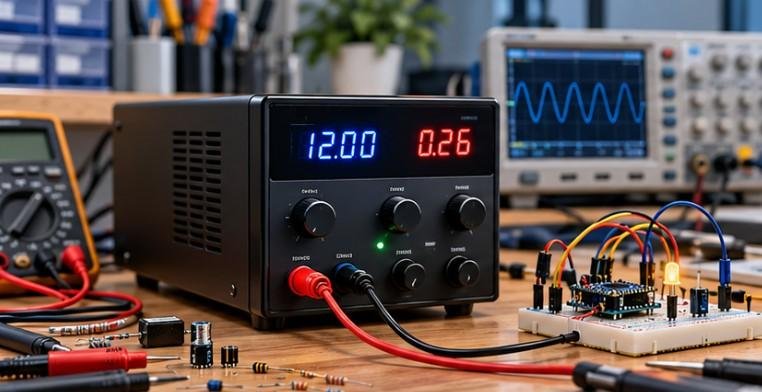
A 30-volt power supply capable of delivering several amps can destroy a prototype far faster than most beginners expect. The feature that often saves the circuit is not higher wattage, a brighter display, or even laboratory-grade accuracy. It is a properly configured current limit.
That is why an adjustable benchtop DC power supply review for electronics lab use should focus on regulation, current limiting, ripple, protection, and control—not simply the biggest voltage and amperage numbers on the front panel.
For US hobbyists, engineering students, robotics builders, and small electronics labs, a 0–30 V supply in roughly the 3–5 A range remains one of the most versatile configurations. But the right design depends heavily on what you intend to power.
Why a Bench Supply Changes the Way You Debug Electronics
A fixed wall adapter tells you whether a circuit works at one voltage. An adjustable laboratory supply lets you investigate why it works, where it fails, and how much current it actually consumes.
You can start a microcontroller board at a deliberately low current limit, increase voltage slowly, identify unexpected current draw, test motors under different operating conditions, and watch a prototype transition between normal and fault conditions.
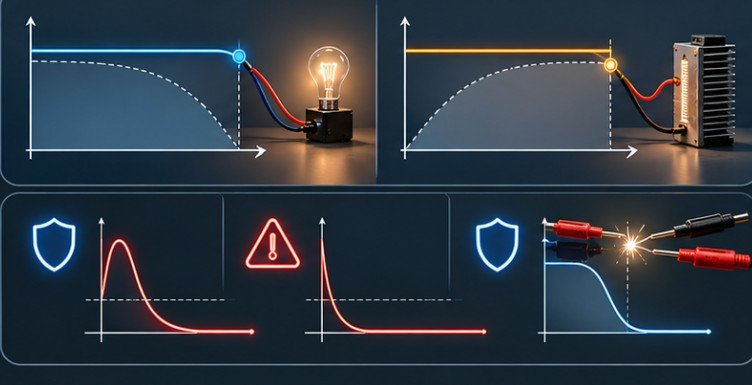
The University of Central Florida’s electrical engineering lab material explains the distinction clearly: in constant-voltage operation, the load determines current according to Ohm’s law. If resistance becomes very low, current can become destructive, so the supply’s maximum-current setting becomes an important protection mechanism.
That feature is especially useful when assembling a new robotics kit for beginners, where reversed connections, wiring mistakes, motors, sensors, and unfamiliar modules can all create unexpected loads.
Linear or Switching? The Choice Affects More Than Weight
The first major decision is power-supply architecture.
Linear Supplies Favor Clean Measurements
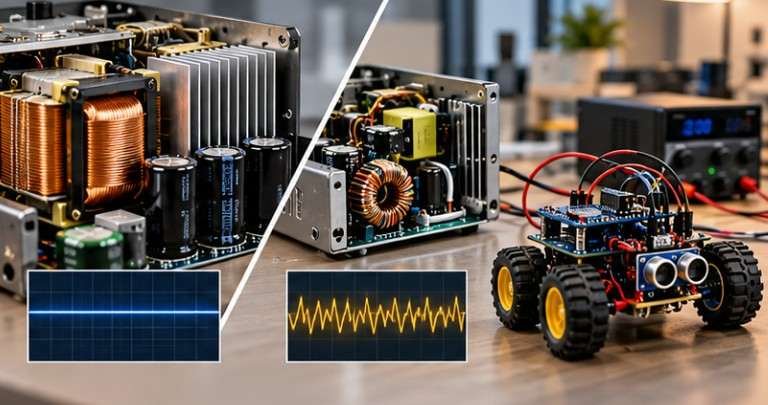
Traditional linear bench supplies are usually heavier because their design commonly relies on substantial transformers and linear regulation. The payoff is generally low output noise and ripple.
That makes them attractive for analog amplifiers, sensor circuits, audio projects, precision measurement work, and experiments where small unwanted electrical signals can interfere with what you are trying to observe.
The University of Utah’s electronics laboratory materials, for example, treat output ripple as a meaningful design parameter in regulated DC supplies because electronic loads require stable voltage rather than merely nominal voltage.
Switching Supplies Favor Power Density
Switch-mode units can provide significantly more current in a smaller, lighter enclosure. Affordable 30 V/10 A models have therefore become common on US workbenches.
Their weakness is that switching converters can introduce high-frequency noise. A well-designed switching supply may still perform perfectly for robotics, motors, LEDs, microcontrollers, battery-related experiments, and general repair work.
The issue becomes more important around sensitive analog circuitry. Stanford electrical-engineering laboratory material specifically highlights noise control in switching-converter work because noise can affect voltage and current measurements used by control circuitry.
For general hobby electronics, I would not automatically reject a switching model. I would simply avoid buying one based on maximum amperage alone.
Three Bench Supplies Worth Understanding
Rather than declaring one unit universally best, it makes more sense to look at three equipment classes.
Korad KA3005P: A Strong Single-Output Lab Format
The Korad KA3005P has become popular among electronics hobbyists because its roughly 0–30 V, 0–5 A range covers most breadboard, Arduino, sensor, small-motor, amplifier, and repair work.
Its appeal is the combination of linear regulation, fine digital adjustment, current limiting, stored settings, and a traditional single-output laboratory format.
For a home electronics bench, this is often a more sensible specification than chasing 10 or 20 amps that may rarely be used.
Korad KD3005D: Simpler Controls, Similar Core Capability
The KD3005D targets users who need controlled variable DC power without extensive programming features.
A basic supply with a clear voltage/current display, dependable CV/CC operation, thermal protection, and short-circuit protection can be more useful than a feature-packed model with awkward controls.
That is particularly true in teaching environments where students constantly change voltages and current limits.
Siglent SPD3303X-E: Better for Multi-Rail Development
The Siglent SPD3303X-E steps into a different laboratory class. Siglent specifies two independently adjustable 0–32 V, 0–3.2 A channels plus a third selectable 2.5/3.3/5 V channel. Total rated output is 220 W.
The two main channels can also be used independently, in series, or in parallel, making the instrument useful for dual-rail analog circuits and systems requiring multiple supply voltages. The X-E model provides 10 mV/10 mA resolution and supports remote operation through USB and LAN.
For automated testing, engineering development, or a shared laboratory, those capabilities can justify the higher price.
Five Features I Would Check Before Buying
An adjustable benchtop DC power supply review for electronics lab work becomes much more useful once you stop treating voltage range as the primary specification.
1. A Real Adjustable Current Limit
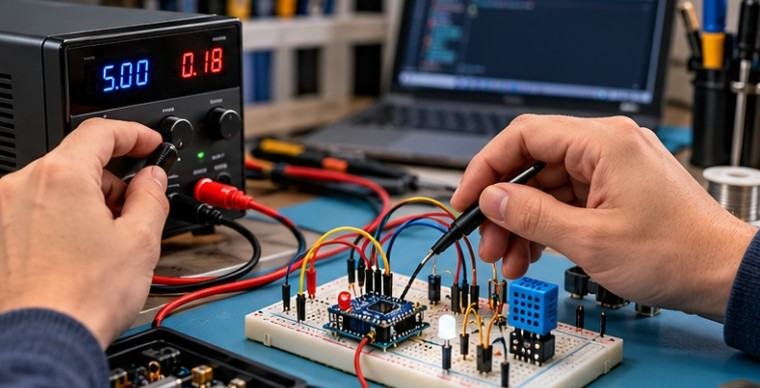
Set the limit before energizing an unfamiliar prototype. MIT’s electronics laboratory instructions use exactly this workflow: select voltage, select the maximum current permitted, connect the circuit while the output is disabled, and then activate the channel. The current setting is explicitly used to protect the circuit.
2. A Separate Output Button
This sounds minor until you use it every day. A dedicated output-enable control lets the supply remain powered and configured while the circuit stays electrically disconnected. You can adjust settings first and energize the project only when ready.
3. Low Ripple and Noise
For digital projects, a few extra millivolts of ripple may make little practical difference. For audio, instrumentation, ADC work, low-level sensors, or RF experiments, it can matter considerably.
Do not confuse display resolution with output quality. A meter showing 12.000 V does not prove that the output contains negligible ripple.
4. OVP, OCP, and Short-Circuit Protection
Look for over-voltage protection, over-current protection, thermal protection, and predictable short-circuit behavior.
For equipment used in a serious US lab, certification also deserves attention. OSHA’s Nationally Recognized Testing Laboratory program lists standards including UL 1012 for power supplies and UL 61010 requirements covering measurement and laboratory equipment.
5. Usable Controls
Good coarse/fine knobs or responsive digital encoders matter more than they appear on a specification sheet.
If moving from 5.0 to 12.0 V requires dozens of slow encoder turns, the supply quickly becomes irritating. Memory presets are especially useful if you repeatedly test 3.3 V, 5 V, 9 V, 12 V, and other common rails.
One Safety Habit Matters More Than the Specifications
Do not change wiring while the output is energized. The University of Pennsylvania’s laboratory electrical-safety guidance recommends de-energizing power supplies before working on experimental wiring or components.
That rule sounds elementary, but rushed bench work is where accidental shorts occur.
Also remember that a current limit protects against many mistakes, not every mistake. Output capacitors can briefly deliver stored energy, and incorrect voltage can damage a component even when current is restricted.
FAQ
1. Is a 30 V 5 A power supply enough for an electronics lab?
For most breadboards, microcontrollers, sensors, op-amps, small motors, LEDs, and repair work, yes. High-power motors, amplifiers, and battery testing may require more current or voltage.
2. Is a linear supply better than a switching supply?
Not universally. Linear supplies generally suit noise-sensitive analog work. Switching models offer better size, efficiency, and high-current value for robotics, motors, digital circuits, and general experimentation.
3. What does CC mode mean on a bench power supply?
CC means constant current. The supply reduces its output voltage as necessary to keep current from exceeding the limit you selected.
4. Should I buy multiple output channels?
Multiple channels are valuable for dual-rail amplifiers, mixed-voltage prototypes, and automated testing. Simple Arduino or breadboard projects usually work well with one adjustable channel.
The Best Supply Is the One That Fails Safely
The biggest number printed on the front panel is rarely the best reason to choose a power supply. For a general US electronics bench, I would prioritize dependable CV/CC behavior, a useful 0–30 V range, adjustable current limiting, low ripple, output enable, short-circuit protection, and controls that make frequent adjustments easy. Move toward linear regulation when sensitive analog measurements dominate your work, and toward higher-current switching designs when power density matters more.
Ultimately, a good adjustable benchtop DC power supply review for electronics lab use should answer one question above all: when your prototype has a mistake—and eventually it will—does the supply help you find it before the circuit pays the price?