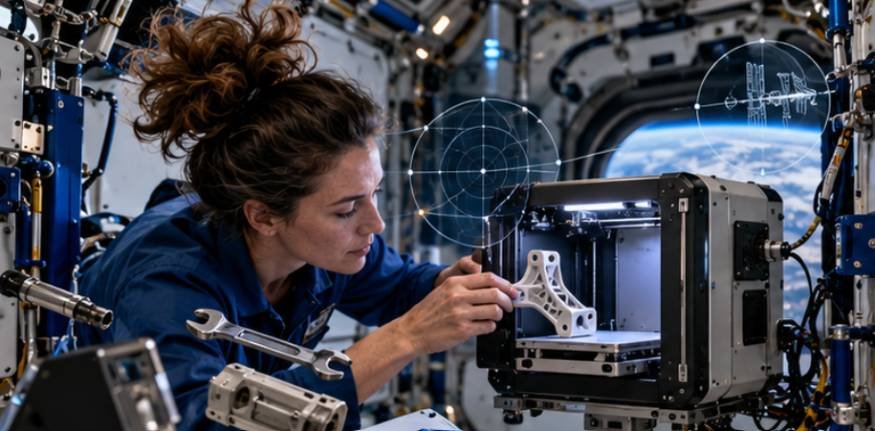
In 2014, astronauts aboard the International Space Station produced the first 3D-printed object ever made in space. What looked like a small plastic part represented something much bigger: spacecraft might no longer need to leave Earth carrying every tool, spare part, and structural component they could possibly need.
That shift explains how 3d printing is changing space exploration. Additive manufacturing is moving production closer to where equipment is actually needed—from rocket factories on Earth to orbit, and eventually to the surfaces of the Moon and Mars.
The result could be lighter launches, faster repairs, radically different spacecraft designs, and missions that depend less on constant deliveries from Earth.
Space Exploration Has a Logistics Problem
Every kilogram launched from Earth occupies payload capacity and requires energy to accelerate into space. Engineers therefore face an uncomfortable tradeoff: carry enough spare components to prepare for failures, or save mass and accept greater logistical risk.
Traditional exploration missions work largely like remote expeditions. Equipment is manufactured on Earth, tested, packed, launched, and stored until needed.
3D printing introduces another option.
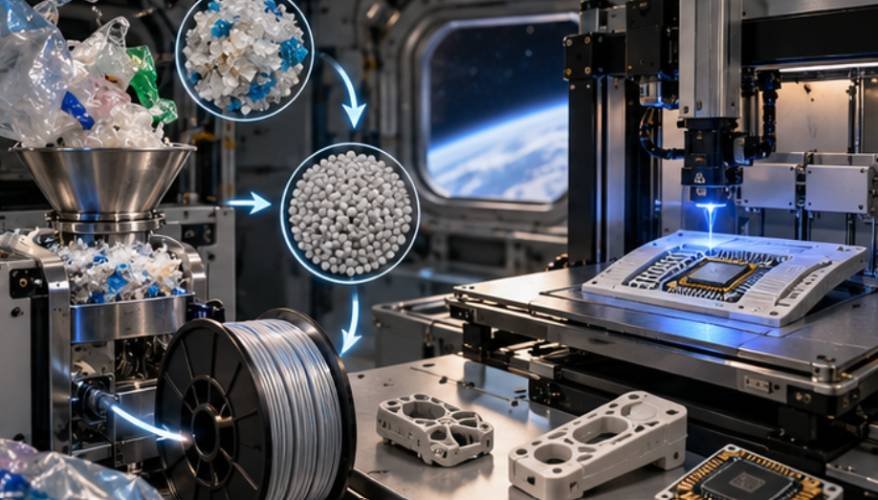
Instead of sending 20 specialized replacement parts, engineers might send printable raw material plus digital design files. An astronaut could manufacture the needed component after determining exactly what failed.
NASA demonstrated the basic idea when its first spaceborne printer began operating on the ISS in 2014. The agency described the experiment as an early step toward an on-demand “machine shop” away from Earth.
That capability becomes increasingly valuable as missions travel farther from home.
Printing Replacement Parts Where They Are Needed
On the ISS, receiving replacement hardware is inconvenient. On Mars, waiting for the next supply spacecraft could take months.
Additive manufacturing changes the inventory model from “store the physical object” toward “store the design.”
A crew could theoretically maintain a digital catalog containing brackets, clips, housings, tools, adapters, and other non-critical components. If something breaks, the appropriate file could be printed rather than retrieved from a warehouse full of spares. The implications go beyond convenience.
NASA researchers see in-space manufacturing as one component of making long-duration missions more self-reliant.
This is a natural extension of the original purpose of additive manufacturing itself. If you’re interested in how the technology reached this point, the origin story of why 3D printing was invented shows how prototyping technology evolved into a serious manufacturing system.
Rocket Engines Are Becoming Easier to Build
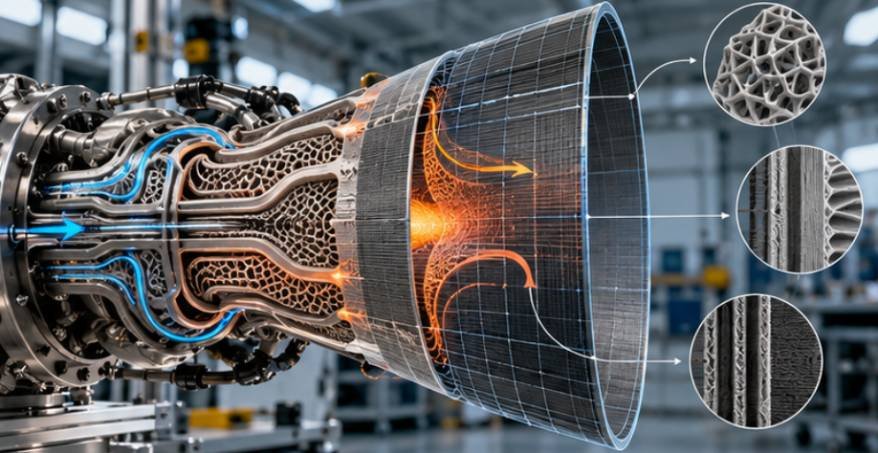
Some of 3D printing’s biggest space benefits happen before a rocket ever leaves Earth.
Rocket engines contain complicated cooling channels, injectors, chambers, nozzles, and joints. Traditional manufacturing can require numerous components to be machined separately and then welded, brazed, or bolted together. Metal additive manufacturing can consolidate several of those pieces into one structure.
NASA’s 2024 Invention of the Year included a thrust-chamber manufacturing technique combining 3D printing with large-scale additive manufacturing. NASA reported that its design eliminated complex bolted joints and achieved an overall mass reduction of more than 40%. Fewer individual parts can also mean fewer interfaces where defects or leaks might develop.
Oak Ridge National Laboratory has worked with NASA to study residual stresses inside 3D-printed rocket components—an important reminder that printing a component is only half the problem. Engineers must prove it will survive flight.
The Bigger Goal: Print With Moon or Mars Material
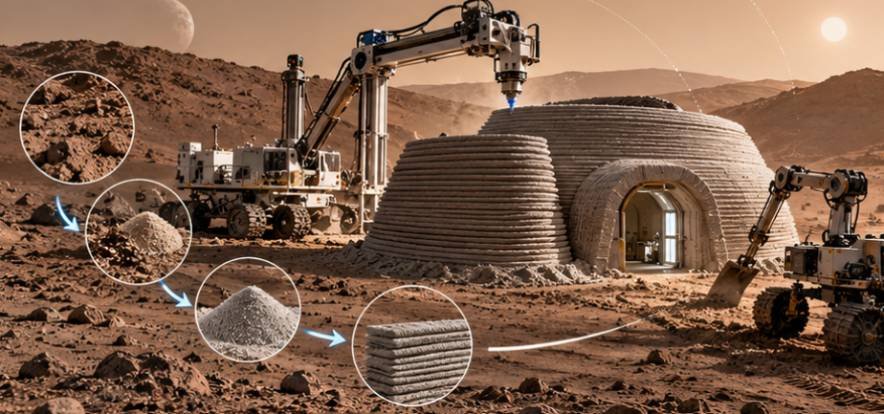
Transporting construction materials from Earth for an entire lunar or Martian settlement would be enormously demanding. A more attractive possibility is in-situ resource utilization, or ISRU: manufacture useful things from material already available at the destination.
Turning Regolith Into Infrastructure
NASA’s 3D-Printed Habitat Challenge explored automated methods of producing shelters from materials similar to those available on deep-space destinations. The competition ultimately awarded more than $2 million while advancing technologies for robotic construction.
Penn State researchers involved in this field have investigated printable construction mixtures additive manufacturing research for Mars habitats and robotic systems designed for extraterrestrial habitats.
The same principle could eventually extend beyond houses.
Potential applications include:
- landing pads that reduce dangerous dust
- radiation-protective barriers
- equipment shelters
- roads and prepared surfaces
- storage structures
- replacement components
Research highlighted by the National Science Foundation has even combined simulated Martian regolith with titanium alloy. A mixture containing 5% simulated Martian material produced stronger results than pure titanium alloy in that study, while components containing 100% simulated regolith were brittle.
That illustrates both the promise and the limitation: local soil is useful, but turning it into dependable engineering material is not as simple as loading dust into a printer.
Sensors and Electronics Could Be Printed Too
The future space printer may produce much more than plastic brackets.
Florida A&M University researchers supported by NASA are developing printable materials that could be used for sensors, antennas, flexible circuits, and radiation-related applications. Their work includes specialized MXene-based materials and nanoparticle inks intended for advanced manufacturing environments.
This matters because repairing electronics traditionally requires carrying complete replacement assemblies.
If future systems can deposit conductive materials onto curved surfaces, astronauts might someday manufacture or repair certain electronic functions directly where they are required.
The same ability to create highly specialized structures is already transforming other fields, including the wild 3D printing uses in medicine.
Could Spacecraft Recycle Their Own Printed Parts?
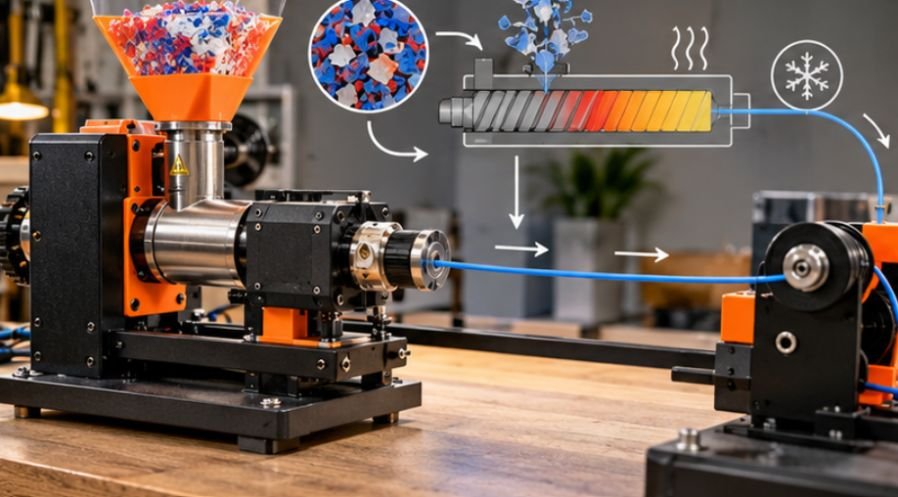
Perhaps the most ambitious idea is closed-loop manufacturing. Instead of continually consuming fresh filament, astronauts could recycle packaging, obsolete parts, or failed prints and turn them into new feedstock.
Achieving this closed-loop approach requires reliable methods for converting discarded prints and obsolete polymer components into usable manufacturing material. The same principles apply to how to recycle failed 3D prints into new filament at home, where careful material sorting, contamination control, drying, and extrusion consistency determine whether recovered plastic can be reused successfully.
NASA’s Refabricator experiment attempted to demonstrate an integrated recycler and 3D printer aboard the ISS. The goal was to convert polymer material back into usable manufacturing stock.
The experiment also provides an important reality check.
A later NASA in-space manufacturing portfolio report noted that the Refabricator did not complete its planned demonstration, with problems including filament breakage and foreign-object debris.
That failure is useful engineering data rather than evidence that recycling cannot work. Space manufacturing systems must operate reliably for months or years with minimal maintenance, making reliability as important as print quality.
Where 3D Printing Creates the Most Mission Value
| Application | Main Advantage | Biggest Challenge |
| Tools and spare parts | Reduces inventory of physical spares | Material and part certification |
| Rocket engines | Fewer parts and complex internal geometries | Defects, inspection, qualification |
| Lunar/Martian habitats | Uses local material instead of launched construction mass | Regolith processing and structural reliability |
| Printed electronics | Customized sensors and circuits | Precision and durability |
| Recycling systems | Reuses waste as manufacturing feedstock | Material degradation and equipment reliability |
A useful way to judge whether something belongs on a future space printer is to ask three questions: Is the part unpredictable, expensive to transport, and manufacturable from available feedstock? The more answers are “yes,” the stronger the case for producing it locally.
Why 3D Printing Will Not Replace Conventional Manufacturing
It is easy to imagine spacecraft printing almost anything they need. Reality is more complicated. Critical pressure vessels, engine components, life-support hardware, and structural parts require rigorous qualification. Small variations in powder quality, temperature, print orientation, or internal porosity can change performance.
The National Institute of Standards and Technology emphasizes that measurement and standards remain central to expanding additive manufacturing in aerospace and other demanding industries.
Printers also require electrical power, maintenance, feedstock, spare components, and quality-control equipment.
For the foreseeable future, additive manufacturing will complement rather than eliminate conventional production.
Frequently Asked Questions
1. Can astronauts currently 3D print parts in space?
Yes. Additive manufacturing experiments have operated aboard the International Space Station, demonstrating that astronauts can produce polymer components in microgravity.
2. Can Moon dust really be used for 3D printing?
Potentially. Researchers are testing simulated lunar and Martian regolith for construction and manufactured components, although processing, strength, consistency, and durability remain major engineering challenges.
3. Are 3D-printed rocket parts safe?
They can be when properly designed, inspected, tested, and qualified. NASA has successfully tested additively manufactured propulsion components, including injectors and combustion-chamber technologies.
4. Will astronauts eventually print entire Moon bases?
Possibly, but probably not as single printed structures. Automated systems may print foundations, walls, shielding, landing surfaces, and other infrastructure while conventional systems provide specialized components.
The Factory May Become Part of the Spacecraft
The most important lesson about how 3d printing is changing space exploration is not that astronauts can make plastic tools. It is that manufacturing itself can travel with the mission.
A Mars crew cannot depend on overnight delivery. A lunar outpost cannot economically import every wall, replacement bracket, and spare component forever. The farther humans travel, the more valuable local manufacturing becomes.
The breakthrough, therefore, is not simply a better printer. It is the transition from carrying everything humans might need to carrying the ability to make what they need. That could become one of the technologies that turns temporary expeditions into sustainable exploration.