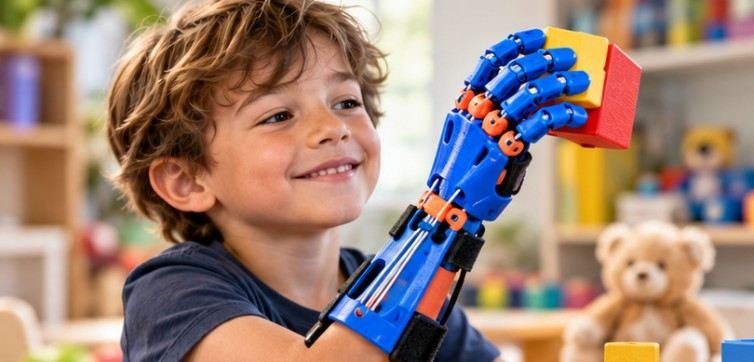
A functional prosthetic hand can be made from desktop-printed plastic, elastic cord, nylon line, straps, and a handful of inexpensive hardware. One documented open-source design, the Cyborg Beast, was built with about $50 in materials—a striking contrast with conventional prosthetic technology that can cost far more.
That affordability explains the growing interest in 3d printed prosthetic hands for kids open source designs. But inexpensive does not mean medically interchangeable with a professionally prescribed prosthesis. The most useful way to understand these devices is as customizable assistive tools: potentially valuable for grasping, play, experimentation, and independence when they are properly selected and fitted.
Why Open-Source Prosthetic Hands Matter More for Children
Children present an unusual prosthetics problem: they grow. A device that fits today may become uncomfortable or unusable as the child’s hand, wrist, and forearm change. Replacing a sophisticated prosthesis repeatedly can create financial and logistical barriers for families.
Open-source manufacturing changes that equation. Once the digital files exist, components can be resized, reprinted, modified, and replaced without manufacturing an entirely new commercial device.
The NIH 3D e-NABLE collection brings many of these designs together in a public repository. It includes downloadable assistive-device models and variations developed through the e-NABLE maker community.
For children, customization can also make the device less clinical. Different colors, patterns, and shapes can turn something that looks like medical equipment into something the child actively wants to show friends.
How a Printed Mechanical Hand Actually Grips Something
Many popular pediatric designs do not contain motors or electronics. They are body-powered.
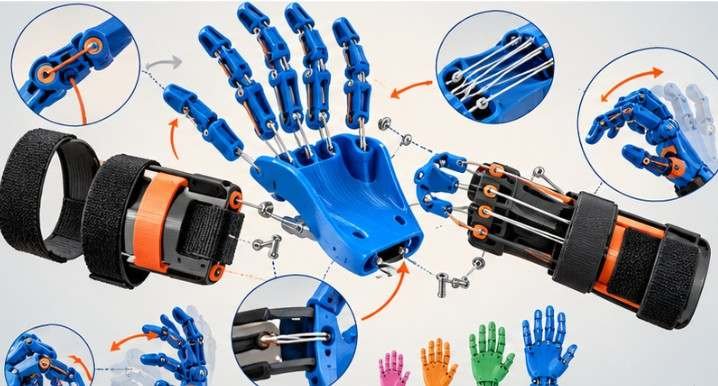
Consider the Phoenix Hand v3. NIH describes it as a wrist-powered design intended for users who retain enough palm structure and functional wrist motion. Flexing the wrist tensions artificial tendons, pulling the printed fingers toward the palm. Releasing the wrist allows elastic components to reopen the fingers.
That simplicity is important. There are no batteries to charge, software updates to install, or miniature motors to replace. The tradeoff is that the child must have the anatomy and range of motion required to operate the mechanism.
The principle is similar in the Cyborg Beast. Its original research description says non-elastic cords flex the fingers while elastic cords reopen them. Approximately 20–30 degrees of wrist flexion activates the grip.
Open-Source Designs Worth Knowing
There is no single “best” printed prosthetic hand. Anatomy, wrist function, age, intended activities, comfort, and professional assessment matter more than popularity.
| Design | How it works | Best-known characteristic |
| Phoenix Hand v3 | Wrist-powered | Lightweight design with downloadable files and assembly resources |
| UnLimbited Phoenix | Wrist-powered | Thermoformed gauntlet and simplified palm construction |
| Cyborg Beast | Wrist-powered | Well-documented early low-cost pediatric design |
| Ody Hand | Wrist-powered | Designed as a starter device for children with small palms and no fingers |
| Kinetic Hand | Wrist-powered | Modern open-source design intended for partial-hand differences |
The Ody Hand is especially interesting because NIH describes it specifically as a starter hand for children with no fingers, a small palm, and enough wrist flexion and extension to operate the mechanism.
Free 3D Hands offers another approach with its Kinetic Hand. The organization provides downloadable files under an open-source license and describes the device as body-powered for people with congenital hand differences who retain functional wrist movement.
These projects demonstrate why understanding how to design 3D print models matters beyond hobby printing: scaling, geometry, tolerances, material selection, and fit can directly affect whether an assistive device works comfortably.
What Does It Cost to Make One?
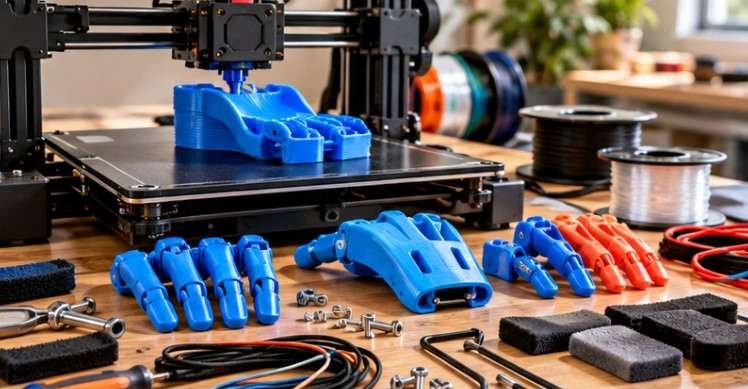
“Cheap prosthetic” can be misleading because printing filament is only one part of the build.
The original Cyborg Beast documentation listed materials including PLA or ABS plastic, nylon cord, elastic cord, Velcro, padded foam, screws, and a tensioning mechanism. The estimated materials cost was about $50.
Other designs may cost more or less depending on filament, hardware, failed prints, padding, replacement parts, and access to a printer.
The major economic advantage is repairability.
A damaged finger may mean printing another finger rather than replacing an entire device. A child who grows may need resized components instead of a completely different manufacturing process.
That repair-and-reprint model is one reason these devices stand apart from many other useful things to 3D print for daily life.
What Research Says About Real-World Function
Open-source hands are impressive, but expectations need to remain realistic. A study indexed by the National Library of Medicine followed 76 children ages 5–18 using 3D-printed prosthetic hands. Participants could handle lightweight objects such as a tennis ball, tray, or water bottle, but more complicated movements and heavier objects remained difficult.
After three months, 61.8% were completely satisfied. Reported problems included broken parts and damaged cords or elastic components. That finding captures both sides of the technology.
A printed hand can create useful gross grasp without sophisticated robotics. But it does not reproduce normal hand dexterity, sensation, strength, or fine motor control.
A Five-Step Test Before Choosing a Design
Families and makers should evaluate suitability before downloading the most attractive STL file.
1. Identify the child’s limb difference
A partial-hand difference, missing fingers, below-elbow difference, and above-elbow difference require different mechanical solutions.
2. Check available joint movement
Wrist-driven designs need usable wrist motion. If the child cannot generate the movement required to tension the tendons, that particular mechanism may provide little benefit.
3. Define the task
Ask what the child wants to accomplish. Holding a bicycle handle, stabilizing an object, carrying a lightweight container, or participating in play may demand different gripping characteristics.
4. Measure and fit carefully
Printed geometry can be resized digitally, but scaling the STL is not enough. Pressure points, straps, padding, wrist alignment, and skin contact all matter.
UNC-Chapel Hill’s Helping Hand Project is one example of a university-supported program that has used open-source and customized designs to produce prosthetic hands for children free of charge.
5. Involve a qualified medical professional
This is the step makers should never treat as optional.
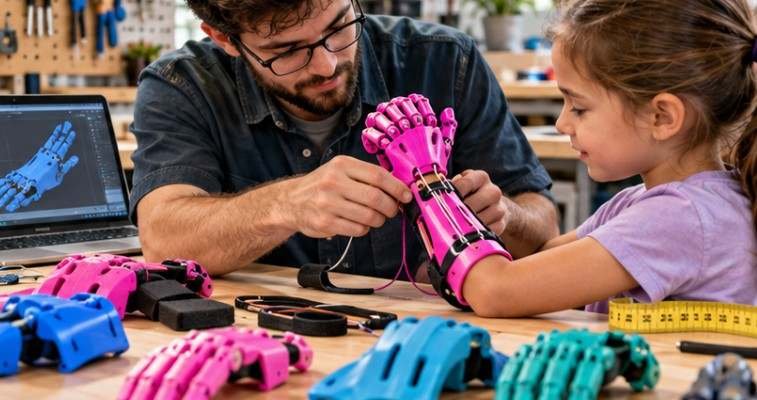
e-NABLE’s own guidance recommends involving a physician, occupational therapist, physical therapist, or prosthetist when using an open-source device.
The Safety Limits Makers Cannot Print Away
Open-source files do not automatically make a device clinically appropriate. e-NABLE warns that its experimental mechanical hands should not be used for operating heavy machinery, equipment, vehicles, or demanding tasks. Its safety guidance describes them primarily as devices capable of gross grasp involving relatively light, pliable objects.
Skin irritation, excessive sweating, pressure areas, broken tension cords, loose components, and poor fit also require attention.
This is particularly important for younger children. A device that looks like a toy still has moving parts and mechanical failure points.
Open source also does not mean “medically approved.” Design licenses, testing histories, and intended-use statements differ. Families should distinguish between experimental assistive devices and regulated clinical prostheses rather than treating the two categories as equivalent.
Frequently Asked Questions
1. Are 3D-printed prosthetic hands safe for children?
They can be appropriate for some children, but fitting and use should involve a physician, occupational therapist, physical therapist, or prosthetist. Open-source designs may be experimental rather than medically approved products.
2. Can a child move the fingers independently?
Most mechanical open-source hands close multiple fingers together using wrist or elbow movement. They generally provide gross grasp rather than independent finger control or biological-hand dexterity.
3. How much does a 3D-printed prosthetic hand cost?
Costs vary. The documented Cyborg Beast used roughly $50 in materials, although printer access, hardware, padding, replacement components, labor, and fitting can increase total expense.
4. Where can open-source prosthetic hand files be downloaded?
NIH 3D hosts an e-NABLE prosthetics collection, while organizations such as e-NABLE and Free 3D Hands publish downloadable models, instructions, and assembly resources.
Bigger Innovation Is the Ability to Keep Improving the Hand
The most important thing about 3d printed prosthetic hands for kids open source designs may not be the plastic itself. It is the ability to improve the design repeatedly.
Engineers can change finger geometry. Volunteers can simplify assembly. Families can replace damaged components. Researchers can test grip mechanisms. Communities can reproduce improvements without waiting for a proprietary manufacturer to build an entirely new product.
Free 3D Hands follows exactly that philosophy by freely publishing designs such as its Kinetic Hand so others can manufacture, evaluate, repair, and continue developing them.
A $50 printed hand will not suddenly become a biological hand, and it should never be sold to families with that expectation. Its real promise is more practical: an assistive device can now be customized, tested, broken, repaired, resized, and improved without starting from zero. For a growing child, that flexibility can matter almost as much as the hand itself.