An all-metal hotend can handle heat and still produce disappointing carbon fiber prints. I would check nozzle wear, printer fit, and filament moisture before blaming the brand.
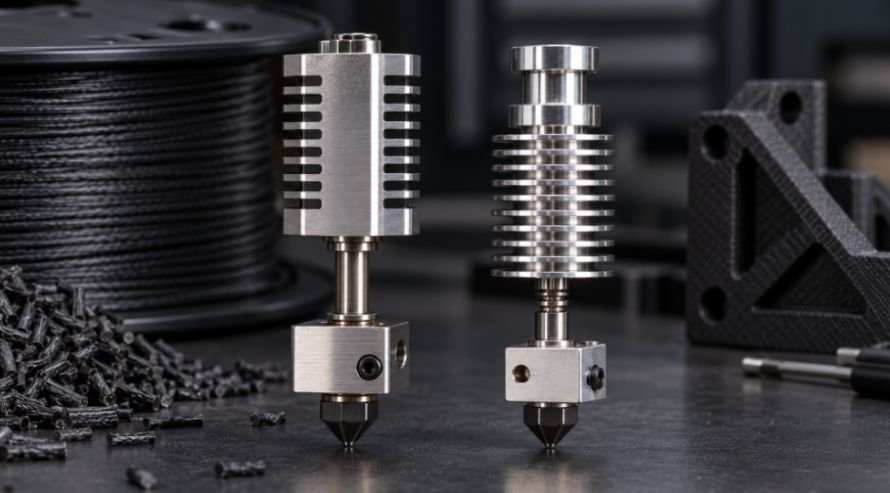
My answer to micro swiss vs e3d v6 for printing carbon fiber filament starts with your existing machine. A compatible Micro Swiss kit simplifies installation. A genuine E3D V6 offers a modular route for printers designed around its mounting system.
Neither choice fixes wet nylon or makes an ordinary brass nozzle suitable for abrasive filament.
My Verdict: Choose Compatibility First
I would choose the original Micro Swiss all-metal kit for a supported Creality printer when installation simplicity matters most.
I would choose the E3D V6 for an existing V6 toolhead, a custom build, or a planned conversion.
First, identify the base polymer. PLA-CF, PETG-CF, and nylon-CF need different temperatures and handling. “Carbon fiber” describes the reinforcement, not one universal print profile.
Also, distinguish chopped-fiber filament from continuous-fiber printing. Neither hotend adds continuous reinforcement.
All-Metal Hotend Compatibility and Installation
Micro Swiss: Match the Exact Kit
“Micro Swiss” covers several designs. Its original all-metal conversion kit and newer FlowTech products are separate systems.
The Micro Swiss original kit’s compatibility list includes specific Ender and CR-10 models. It explicitly excludes the CR-10 V2. Brand-level compatibility is therefore insufficient.
I would check the complete printer name before ordering. Similar model names can hide different mounting plates, heaters, and connectors. For robotics projects that combine printed parts with electronic components, power planning matters too.
This resource explains how to power a Raspberry Pi robot with 18650 batteries, including considerations for powering a robot reliably.
A mechanical drop-in upgrade also does not automatically authorize higher firmware temperatures. Confirm the heater, sensor, wiring, and printer limits before selecting a hotter material.
For someone choosing a 3d printer for beginner robotics projects, straightforward installation may outweigh extensive customization.
E3D V6: Plan the Conversion
The genuine E3D V6 uses a groove mount and replaceable heater and sensor cartridges. Its standard configuration supports temperatures up to 300°C.
On an incompatible carriage, budget for a mount, fan duct, wiring work, and possible sensor configuration changes.
After installation, verify nozzle position, bed clearance, temperature control, and retraction. Follow the assembly instructions, including the specified tightening procedure.
I would avoid fitting a V6 merely because adapters exist. A conversion should solve a clear limitation.
Hardened Nozzles for Abrasive Carbon Fiber Filament
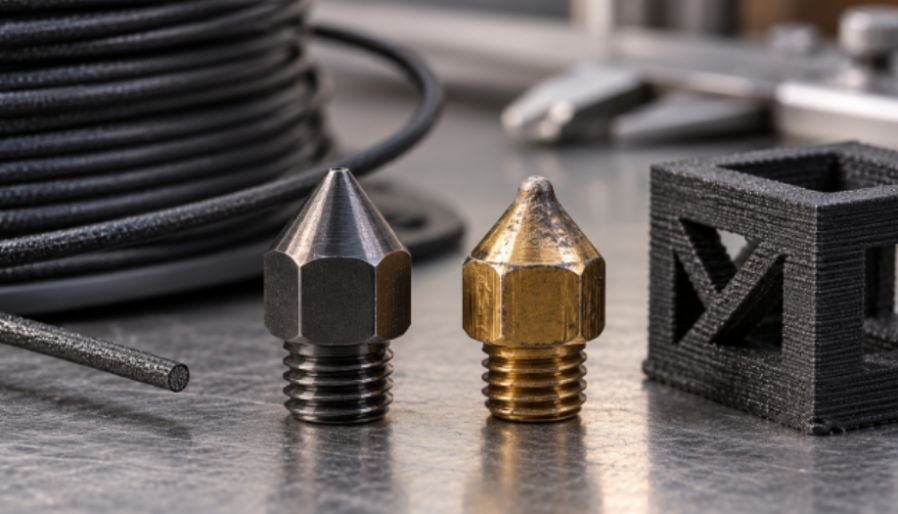
Nozzle selection matters more than the logo on the heatsink. Abrasive fibers wear ordinary brass, changing extrusion behavior and dimensional accuracy.
For regular CF printing, I would start with a compatible hardened-steel nozzle. Check thread length, sealing geometry, and the exact hotend family.
TwinClad XT describes a coating, not necessarily the underlying metal. Micro Swiss sells coated brass as well as hardened options. Identify both before buying. M6 Thread 1.75mm — Microswiss
Likewise, an E3D-branded nozzle is not automatically V6-compatible. Match the product to the V6 system rather than relying on a coating name.
I favor 0.6mm for many fiber-filled functional parts, provided the filament manufacturer supports it. It offers more clearance than 0.4mm, though no diameter eliminates clogs.
Prusa’s composite-material guidance recommends hardened nozzles and identifies 0.4mm as a practical lower limit in its guidance.
After changing nozzle material or diameter, recalibrate temperature, flow, and retraction. Hardened steel conducts heat differently from brass.
Temperature and Flow: Two Different Limits
A 300°C rating tells you the supported temperature, not how quickly a hotend can melt nylon.
E3D specifies additional components for operation above the standard V6’s 300°C configuration. A higher firmware ceiling alone does not provide that capability.
Micro Swiss limits depend on the exact kit and printer hardware. Avoid applying one product’s specification across the entire range.
Neither a standard V6 nor an original Micro Swiss conversion should inherit FlowTech high-flow performance claims.
A Worked Flow-Rate Example
Here is my calculated example, not a measured hotend benchmark.
Approximate volumetric demand equals line width × layer height × print speed.
| Example profile | Calculation | Flow demand |
| Smaller extrusion | 0.45 × 0.20 × 60mm/s | 5.4mm³/s |
| Larger extrusion | 0.66 × 0.30 × 60mm/s | 11.88mm³/s |
The second profile demands 2.2 times as much molten plastic at the same travel speed.
That explains why switching to 0.6mm can expose underextrusion. The larger opening may reduce blockage risk while increasing melting demand.
I would establish a conservative maximum volumetric speed using the actual filament, nozzle, and temperature. Then cap the slicer accordingly.
Nylon-CF Drying and Enclosure Setup
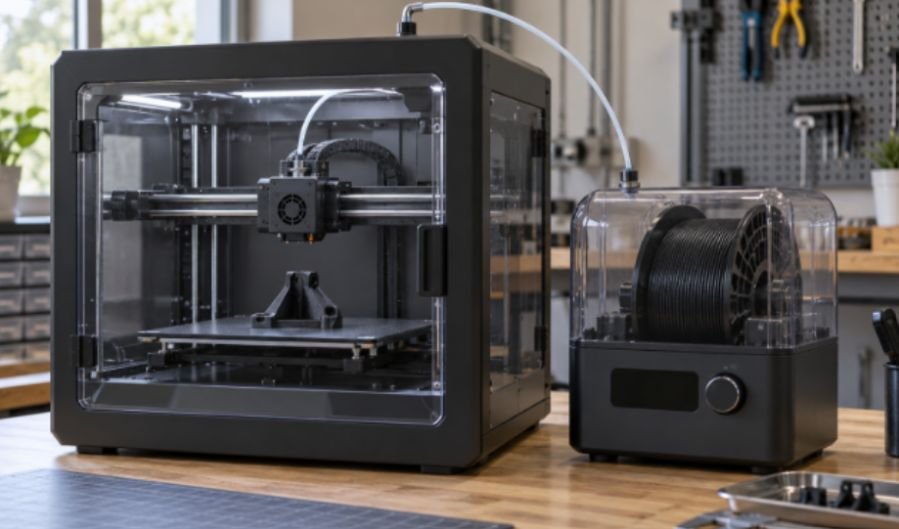
Dry First, Then Protect the Feed
For nylon-CF, I would prioritize drying before replacing a functioning hotend. Moisture can cause popping, rough surfaces, stringing, and inconsistent extrusion.
Use the exact filament’s current drying instructions. PA6-CF, PA12-CF, and other nylon blends do not share one reliable schedule.
For example, Polymaker’s current Fiberon PA6-CF20 instructions specify 100°C for ten hours for its regular-oven drying method. The same page provides a separate PolyDryer schedule. Those instructions belong to that product.
Choose equipment that supports the specified process, and confirm spool temperature tolerance.
After drying, feed from a dry container through a short, gently curved guide path. Desiccant helps maintain dryness; it does not replace the prescribed drying cycle.
Direct drive can simplify routing, but Bowden feeding is not automatically unsuitable. Avoid sharp bends and excessive spool resistance.
Match Chamber Settings to the Material
I would reject a universal “60°C chamber and 100°C bed” nylon profile.
Polymaker’s current PA6-CF20 page specifies a 40–50°C build plate, cooling fan off, and no required active chamber heating. Other formulations can differ substantially.
Use the recommended plate and adhesive. Keep drafts controlled, and remain within the printer’s enclosure temperature rating.
Do not assume either hotend is immune to heat creep. Heatsink airflow, retraction, chamber conditions, and assembly all affect performance.
Treat annealing separately. Follow the material’s schedule, and check critical dimensions afterward.
Which Upgrade Makes Financial Sense?
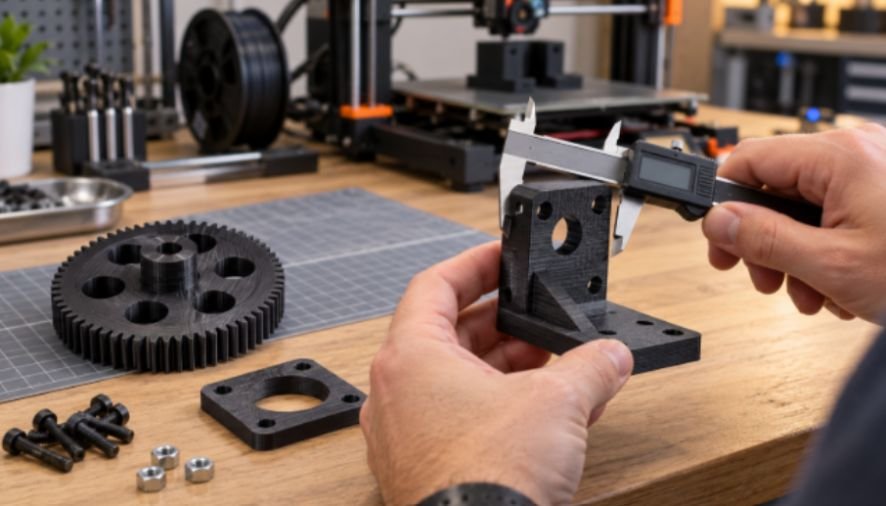
I compare the complete conversion cost: hotend, nozzle, mount, electrical parts, installation time, and calibration waste.
For a supported Ender, Micro Swiss may save enough work to justify its price. For an existing V6 carriage, retaining that ecosystem usually avoids unnecessary conversion.
A working all-metal hotend may need only a suitable nozzle and better filament handling.
When selecting a 3D printer for functional mechanical parts, I also consider dimensional repeatability and layer orientation.
A neat CF surface does not prove that a bracket can withstand its intended load. For a practical example of how printed components can support a robotics build, explore this obstacle-avoiding robot using an ultrasonic sensor and Arduino. It demonstrates how sensors and control electronics can work together in a functional robot.
A neat CF surface does not prove that a bracket can withstand its intended load.
For projects that combine printed components with controlled mechanical movement, this tutorial on how to control a stepper motor with ESP32 and A4988 can help explain how motor drivers and microcontrollers work together.
Stop Feeding the Upgrade Habit
My next step would be a small test coupon using dried filament and a verified wear-resistant nozzle.
Check extrusion consistency, hole dimensions, and layer bonding before committing to a long print. Change one variable at a time.
Buy the hotend that solves your printer’s actual limitation. Give it dry filament and realistic flow settings before shopping again.
Frequently Asked Questions
1. Which wins: micro swiss vs e3d v6 for printing carbon fiber filament?
I favor a compatible Micro Swiss kit for easy installation and E3D V6 for existing V6 mounts or custom builds.
2. Is a 0.4mm nozzle suitable for carbon fiber nylon?
Some blends support it; check their instructions, and consider 0.6mm when detail requirements allow.
3. Does nylon-CF always need a heated enclosure?
No; chamber requirements depend on the specific formulation and manufacturer’s profile.
4. Will an all-metal hotend stop nylon-CF stringing?
No; moisture, temperature, retraction, and feeding problems can still cause stringing.