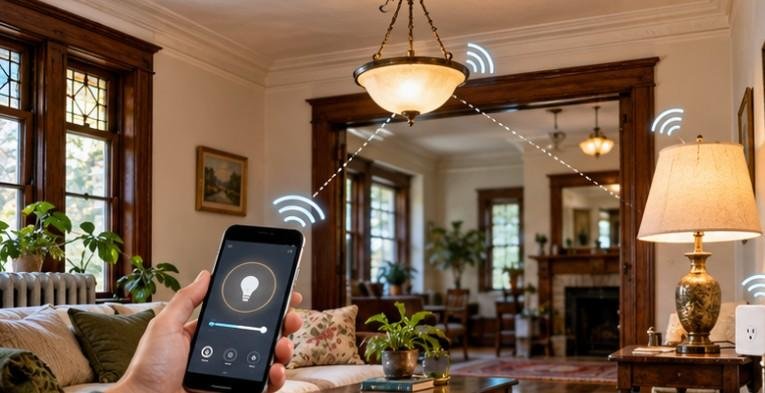
An old house does not need new walls to get new intelligence. In fact, one of the biggest advantages of modern home automation is that many upgrades no longer require cutting into plaster, fishing cable through century-old framing, or replacing historic switches.
The best smart home automation ideas for old homes work around the building rather than fighting it. Wireless sensors, plug-in controls, battery-powered devices, smart bulbs, and carefully chosen switches can add meaningful automation while leaving original trim, doors, and electrical boxes largely untouched.
That matters because older American houses often hide electrical systems that deserve caution. The Electrical Safety Foundation International notes that more than 30 million U.S. homes are at least 50 years old, and aging electrical systems may include ungrounded knob-and-tube wiring or aluminum wiring that requires special attention.
Start With the House, Not the Gadget
Before buying a dozen switches, inspect what the house can safely support. Remove no electrical devices unless you know how to work safely around residential wiring. Instead, note the age of the electrical panel, whether outlets are grounded, whether lights flicker, and whether breakers trip regularly.
ESFI recommends considering a professional electrical inspection when a house is 40 years old or older. Buzzing, hot or discolored outlets, repeated breaker trips, damaged insulation, and shocks are warning signs that should be addressed before automation is added.
Older knob-and-tube wiring deserves particular caution. NFPA research notes that aging wiring systems can develop insulation and arc-fault risks, especially when older circuits face demands they were never designed to carry.
The goal is not to make an old electrical system handle more equipment. It is to automate efficiently around its limitations.
Seven Upgrades That Work Especially Well in Older Houses
1. Use Smart Bulbs Where Wiring Is Questionable
Smart bulbs are among the easiest retrofit tools because the intelligence stays inside the bulb rather than behind the wall.
They are ideal for bedrooms, hallways, porches, and lamps controlled by inconveniently located switches. You can create schedules, nighttime dimming, occupancy routines, and remote shutoff without changing the switch box.
The drawback is behavioral: someone flipping the physical switch off removes power from the smart bulb. Wireless wall buttons or scene controllers can solve that problem without rewiring.
2. Choose No-Neutral Switches Carefully
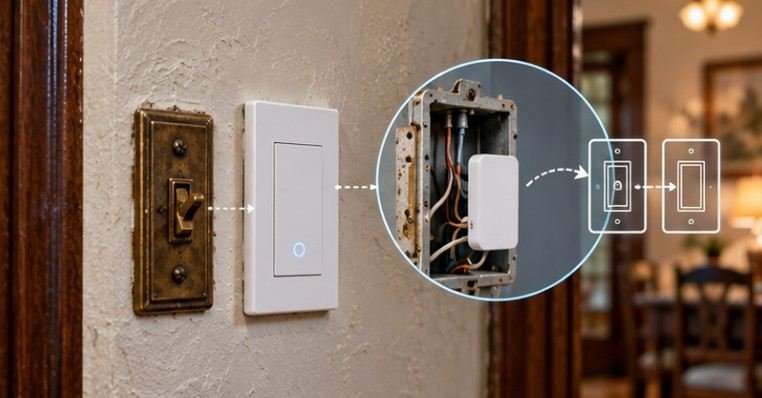
Many conventional smart switches need a neutral conductor to power their electronics continuously. Older switch boxes may contain only the line and switched conductors.
A compatible no-neutral smart switch can sometimes solve the problem, but compatibility must be checked carefully against the fixture type, minimum load requirements, dimming method, and existing wiring.
Do not assume that a product advertised as “no neutral required” automatically makes every old circuit suitable. Unknown, damaged, aluminum, or knob-and-tube wiring deserves professional evaluation.
3. Put Smart Plugs on Low-Risk Everyday Loads
A smart plug can modernize a table lamp, holiday lighting, fan, humidifier, or similar plug-in appliance in seconds.
Useful routines include turning living-room lamps on at sunset, shutting entertainment equipment down overnight, or turning a bedroom fan off after everyone leaves for work.
Avoid treating smart plugs as universal appliance controllers. Space heaters, air conditioners, and other high-current equipment should only be used with controls specifically rated and approved for that load.
Make Water Problems Smart Before They Become Expensive
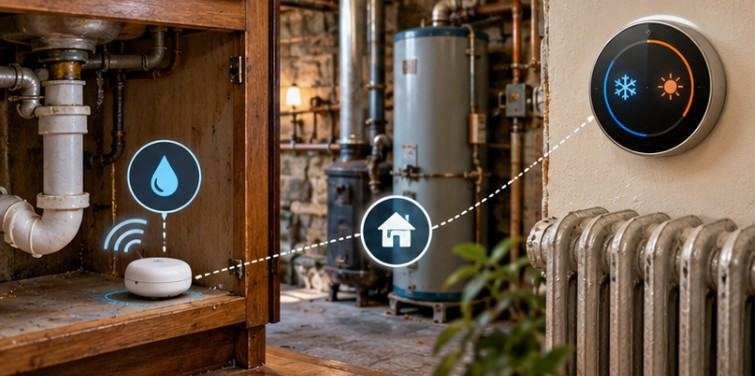
Older houses often contain layers of plumbing from different renovations. That makes wireless leak detection unusually valuable.
Battery-powered sensors can be placed beside a water heater, beneath kitchen and bathroom sinks, behind a washing machine, near a sump pump, and underneath refrigerator water lines.
The automation can be simple: if water is detected, sound an alarm and send a phone notification. More advanced systems can trigger a compatible automatic main-water shutoff valve.
Unlike opening walls for new pipes or wiring, leak sensors are inexpensive, removable, and useful immediately.
Give an Older Heating System Smarter Control
A smart thermostat can be one of the highest-impact upgrades, but compatibility matters more than brand.
Some older furnaces, boilers, radiant systems, and two-wire thermostat installations cannot accept a modern thermostat without an adapter, relay, common-wire solution, or other modification.
ENERGY STAR says certified smart thermostats are evaluated using real-world field data rather than relying solely on laboratory claims. Homes with high heating and cooling expenses or long periods of daytime vacancy can save around $100 annually under suitable conditions.
Do not overlook the building itself, however. Automation cannot compensate for a drafty attic or major air leakage. Colorado State University Extension recommends combining thermostat setbacks with improvements such as insulation, weather sealing, efficient windows, and regular heating-system maintenance.
Keep Historic Doors While Adding Smart Access
Replacing an ornate old door or antique exterior hardware simply to gain app-controlled entry rarely makes sense.
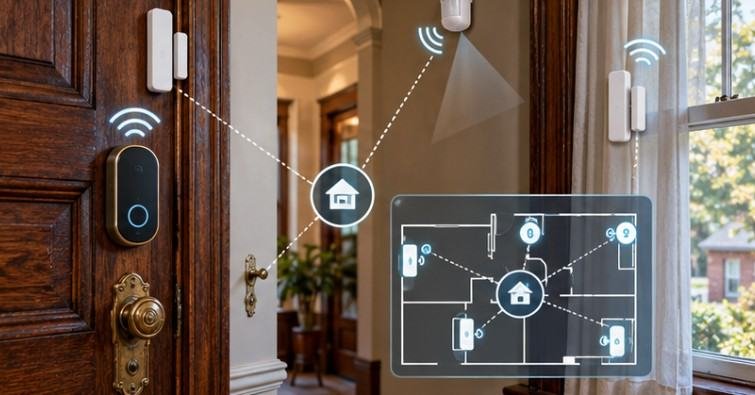
Retrofit smart locks are a better fit. Certain designs mount mainly on the interior side and operate the existing deadbolt mechanism, allowing much of the exterior appearance to remain unchanged.
Before buying, measure the door thickness, backset, clearance around trim, and existing deadbolt. Older doors are not always dimensioned like modern prehung doors, and decades of settlement can make a technically compatible lock struggle against a poorly aligned strike plate.
Door and window contact sensors can also be attached using removable adhesive rather than screws.
Automate Curtains, Hallways, and Staircases Without Opening Walls
Heavy curtains are common in older homes for a good reason: they can help manage drafts and sunlight.
Wireless curtain motors can automate existing drapes so they open for morning daylight and close after sunset. In summer, routines can close sun-facing window coverings during peak afternoon heat.
Motion sensors can handle another old-house problem: poor switch placement. A battery-powered sensor can trigger compatible smart bulbs or wireless lights when someone enters a staircase, basement hallway, pantry, or mudroom.
These small automations often improve daily life more noticeably than an expensive centralized control panel.
Use the One-Room Retrofit Test
Before expanding your system, test automation in one frequently used room for two weeks.
First, check Wi-Fi or hub coverage at every proposed device location. Thick plaster, masonry chimneys, metal lath, and multiple floors can weaken wireless signals.
Next, automate one light and one plug-in device. Add a motion or contact sensor only after those controls work reliably.
Then test what happens when the internet goes down. Ideally, essential switches, locks, and lights should retain basic local operation.
Finally, ask whether the automation actually removed a repetitive task. If you continually override it, simplify the routine rather than adding more rules.
Do Not Ignore the Digital Side of the Retrofit
An old house with new connected devices acquires a problem its original builders never anticipated: cybersecurity.
NIST emphasizes that home routers play a central security role because smart-home IoT equipment relies on the home network. Its consumer-router guidance addresses security capabilities intended to reduce network risks.
Use unique passwords, enable automatic updates where available, remove devices you no longer use, and replace networking hardware that no longer receives security updates. A $20 sensor should not become the weakest door into the rest of your digital life.
Frequently Asked Questions
1. Can I make a 100-year-old house a smart home?
Yes. Wireless sensors, smart bulbs, plugs, thermostats, locks, and retrofit controls can automate many functions without replacing historic construction.
2. Do smart switches work without a neutral wire?
Some models do, but compatibility varies by wiring and lighting load. Have uncertain or aging wiring evaluated before installing an in-wall device.
3. What should I automate first in an older home?
Start with lighting, leak detection, and temperature control. These provide useful daily benefits while requiring relatively little structural modification.
4. Do I need to rewire my house before installing smart devices?
Not necessarily. Wireless and plug-in devices require little or no rewiring, but unsafe or deteriorated electrical systems should be corrected before adding new equipment.
A Smarter House Without Erasing Its History
The smartest retrofit is usually the one you barely notice. A hallway illuminates before you reach the stairs, a leak sensor catches a slow drip, curtains close before a cold night, and the thermostat reduces wasted heating while the house is empty.
The most effective smart home automation ideas for old homes do not begin with tearing out century-old materials. They begin by understanding what the building already has, protecting its electrical system, and adding technology in small, reversible layers. Preserve what gives the house character; automate the inconveniences around it.