
Here is the part that surprises many first-time smart-home buyers: Matter and Zigbee are not really competitors in the traditional sense. One is primarily about making smart devices understand one another across ecosystems, while the other provides the wireless network those devices use to communicate.
That distinction makes matter vs zigbee for home automation beginners much easier to understand. Matter is designed around interoperability across platforms such as Apple Home, Google Home, Amazon Alexa, and others. Zigbee is an established low-power mesh technology that has spent years connecting bulbs, sensors, switches, plugs, and other devices.
For most households, the best answer is increasingly not Matter or Zigbee. It is knowing where each technology fits.
Matter and Zigbee Solve Different Smart-Home Problems
Matter sits at the application layer. In practical terms, it creates standardized rules that compatible smart-home products and controllers can understand.
The Connectivity Standards Alliance describes Matter as an IP-based interoperability standard capable of operating over Wi-Fi, Ethernet, and Thread. Bluetooth Low Energy can also help during device commissioning.
Matter has also continued evolving. The Alliance released Matter 1.6 in June 2026, with improvements involving commissioning and multi-ecosystem device management. Its specification resources now include Matter 1.6.1.
Zigbee works differently. It is a complete wireless IoT stack designed around low-power networking and mesh communication. The Connectivity Standards Alliance says Zigbee maintains backward compatibility with more than a billion deployed devices.
That maturity matters when you are buying inexpensive motion sensors, contact sensors, switches, plugs, or bulbs.
Matter’s Biggest Advantage: Escaping Ecosystem Lock-In

Suppose one person in your home prefers Apple Home while another uses Alexa. Traditionally, buying smart-home products that worked equally well across platforms could become frustrating. Matter is designed to reduce that problem.
Its multi-admin capabilities allow compatible products to participate in multiple smart-home ecosystems instead of belonging exclusively to one vendor’s platform. That means purchasing decisions can increasingly revolve around the product itself rather than the logo printed on the hub.
Matter commissioning is also intended to simplify installation. Depending on the product and ecosystem, setup can involve scanning a QR code or using newer commissioning methods.
But “Matter” Does Not Tell You How the Device Connects
This is one of the most important details beginners miss. A box saying “Matter” does not necessarily mean the device uses Thread.
A Matter smart plug could use Wi-Fi. A battery-powered Matter sensor might use Thread. A television or controller could use Ethernet. That distinction affects battery life, network design, and the equipment you need.
Matter-over-Thread Requires a Border Router
Thread is a low-power IP-based mesh network particularly well suited to battery-powered devices.
Unlike a traditional proprietary hub translating between networking technologies, a Thread border router connects the Thread mesh with the rest of your IP network.
The Thread Group explains that Thread uses IPv6 and that multiple border routers can exist within the same environment.
Before buying Matter-over-Thread sensors, therefore, check whether your existing smart-home equipment already provides Thread border-router functionality.
Without one, purchasing several Thread sensors first and figuring out connectivity afterward can make an supposedly simple installation unnecessarily confusing.
Where Zigbee Still Has a Major Advantage
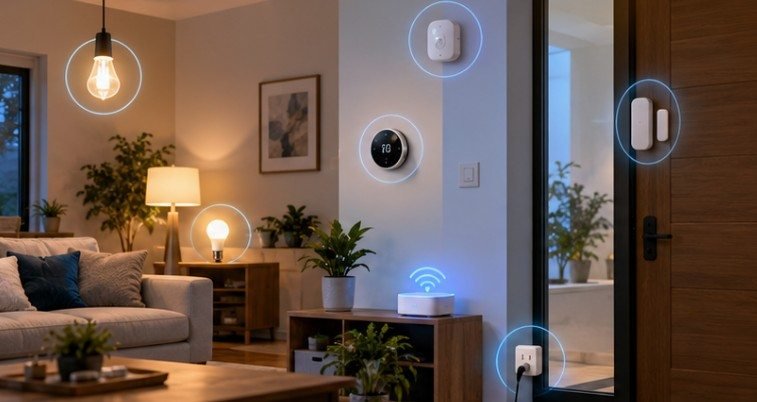
Zigbee’s greatest strength is that it is boring—in a good way. The technology has been deployed for years. There is an enormous selection of Zigbee bulbs, contact sensors, temperature sensors, buttons, smart plugs, motion detectors, and switches.
A properly designed Zigbee installation also becomes stronger as compatible mains-powered routers are added. These devices can relay Zigbee traffic, allowing the mesh to reach devices farther from the coordinator.
Battery-powered sensors generally do not perform that repeating role because constantly routing messages would consume too much energy. The downside is the coordinator.
You typically need a manufacturer’s hub or a general Zigbee coordinator connected to a home-automation platform. Beginners who want nothing more complicated than scanning a QR code may find that extra hardware less attractive.
A Five-Question Test Before You Buy Anything
Instead of choosing a protocol first, answer these questions.
1. Which ecosystems do you use?
If you regularly mix Apple, Google, Alexa, or multiple platforms, Matter compatibility becomes particularly valuable.
2. Are you planning dozens of sensors?
For large networks of inexpensive door, motion, leak, and temperature sensors, Zigbee remains extremely attractive.
3. Do you already own a Thread border router?
If yes, Matter-over-Thread becomes easier to adopt. If not, include that infrastructure requirement in your decision.
4. Do you want local automation?
Check the actual product, controller, and hub rather than assuming either logo guarantees every feature works locally. Cloud-dependent manufacturer features can still exist around otherwise local-capable products.
5. Will the manufacturer support the device?
Protocol compatibility is not the whole security story. NIST’s consumer IoT guidance emphasizes broader product-level security capabilities, while its research has found that ordinary smart-home users can struggle to understand privacy and security risks.
For U.S. buyers, the FCC’s voluntary U.S. Cyber Trust Mark program is another useful development. Qualifying connected products can carry a label and QR code providing security information such as software-support details.
The Smartest Setup May Use Both
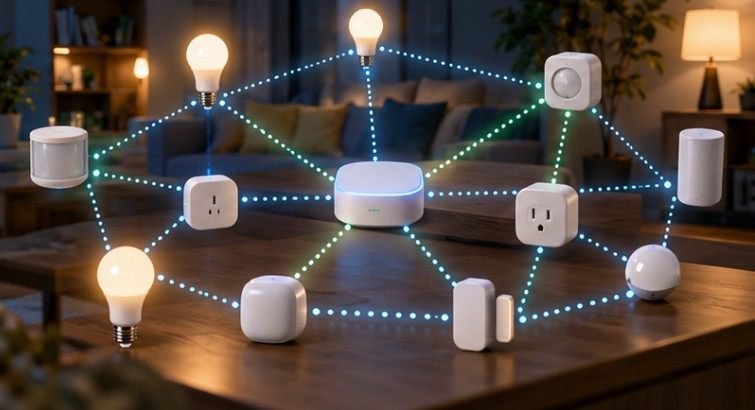
There is little reason to replace a reliable Zigbee network simply because Matter exists. A home could use Zigbee for inexpensive motion sensors, switches, and bulbs while adding Matter-over-Thread locks or sensors and Matter-over-Wi-Fi appliances as better products become available.
Bridges can also expose certain existing device ecosystems to Matter controllers, depending on manufacturer support. The important shift is conceptual: stop thinking of your house as needing one winning wireless protocol. Think of your automation platform as the layer bringing several networks together.
Common Matter and Zigbee Mistakes
Do not confuse Matter with Thread. Matter defines how compatible devices communicate at the application level; Thread is one network Matter can use.
Do not assume every Zigbee product works perfectly with every Zigbee hub either. Certification has improved interoperability considerably, but manufacturer-specific functionality can still affect advanced features.
Finally, do not purchase based solely on protocol logos. Update policies, replacement cost, local-control capabilities, hub compatibility, security, and the quality of the manufacturer’s software matter just as much.
Frequently Asked Questions
1. Is Matter better than Zigbee for beginners?
Not universally. Matter is easier for cross-platform interoperability, while Zigbee can be better for inexpensive, mature sensor networks. Many homes benefit from using both.
2. Does Matter replace Zigbee?
No. Matter solves a different problem, and existing Zigbee networks can remain useful for years while Matter adoption expands.
3. Does Matter need a hub?
Matter-over-Wi-Fi does not necessarily require a traditional hub, but it needs a Matter controller. Matter-over-Thread additionally requires access to a Thread border router.
4. Is Zigbee usable without the internet?
Yes. A properly configured Zigbee network can communicate locally through its coordinator or hub, although individual manufacturer services may still rely on cloud connectivity.
The Better Choice Is a Better Architecture
The debate around matter vs zigbee for home automation beginners sounds like a contest only until you understand what each technology actually does.
If I were building a home from scratch, I would prioritize Matter compatibility for major new products where cross-platform control matters, use Matter-over-Thread for suitable low-power devices, and keep Zigbee on the shortlist whenever I needed reliable, affordable sensors at scale.
The goal is not to predict which logo eventually wins. Build a system that can accommodate several standards, favor products with good local operation and long-term support, and you will have far fewer reasons to rebuild your smart home later.