Debugging autonomous rovers, robotic arms, and motor drivers without visual signal telemetry leads straight to dead ends. When microcontrollers drop packets, sensors reboot under load, or H-bridge MOSFETs overheat, a handheld multimeter shows only an average voltage.
Conducting this budget digital oscilloscope review for hobby robotics stems from years of diagnosing erratic robotic hardware across my home workshop bench. Modern entry-level scopes now deliver deep memory, protocol decoding, and multi-channel capture that once cost thousands of dollars.
Equipping your test bench with the right digital storage scope clarifies whether software logic bugs or physical electrical ringing disrupt your robot.
Why Robotics Debugging Demands More Than a Digital Multimeter
Digital multimeters measure steady-state DC voltage and RMS values well. However, robotics projects deal primarily with dynamic pulsed signals, inductive spikes, and high-speed communications. When a servo chatters erratically, a multimeter reads a calm, averaged 5 volts, missing the severe ground bounce underneath.
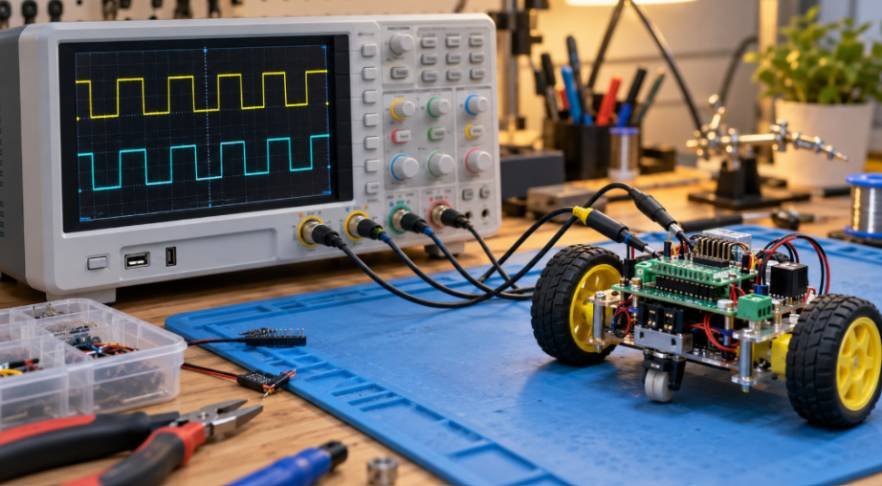
An oscilloscope plots voltage across time, visualizing microsecond ripple, inductive flyback spikes, and transient voltage sag. When motor brushes switch on, they generate high-frequency electromagnetic interference. Identifying these noise spikes prevents random sensor resets on shared power rails.
Decoding Serial Protocols: The Two-Channel Trap
Most beginner oscilloscopes provide two input channels. While sufficient for audio projects or simple square waves, two channels create an immediate bottleneck in robotics.
Modern sensor suites communicate across I2C or SPI buses. The SparkFun Serial Peripheral Interface Tutorial illustrates that standard 4-wire SPI requires Clock (SCLK), Master Out Slave In (MOSI), Master In Slave Out (MISO), and Chip Select (CS).
A two-channel scope cannot monitor a full SPI transaction simultaneously. You must probe lines piecemeal, complicating timing verification. A four-channel instrument captures the full bus handshake in real time, exposing clock jitter and race conditions instantly.
Bench Testing: Analyzing PWM Slew Rates and High-Frequency Ringing
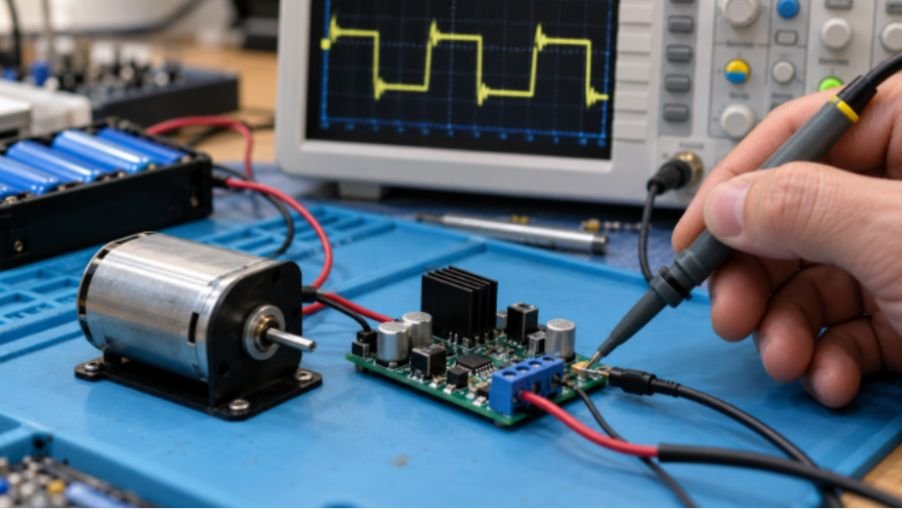
To evaluate these units on real robotics hardware, I configured a dual-motor driver circuit powered by an 11.1V 3S LiPo battery. I drove a coreless DC motor using high-frequency Pulse Width Modulation (PWM) at 20 kHz while inducing mechanical stalls. I measured peak overshoot voltage, gate drive rise time, and communication frame decoding against reference standards outlined in NIST Oscilloscope Calibration Guidelines.
| Oscilloscope Model | Form Factor | Real Bandwidth | Channels | Real Memory Depth | SPI/I2C Decoding |
| Rigol DS1054Z | Benchtop | 50 MHz (Upgrade to 100 MHz) | 4 | 24 Mpts (Single-ch) | Hardware/Software Built-in |
| ZOYI ZT-703S | Handheld Hybrid | 50 MHz | 2 | 3.2 Kpts | None (Waveform Only) |
| Hantek DSO5102P | Benchtop | 100 MHz | 2 | 40 Kpts | None (Triggering Only) |
Memory Depth and Sample Rate: Catching Transient Motor Noise
Headline bandwidth specifications often distract buyers from a more critical metric: record memory depth. According to IEEE Xplore Motor Drive Measurement Standards, capturing complex transients during motor startup requires sustained high sample rates over extended timebases.
A scope with shallow memory drops its real sampling rate as you zoom out to capture a complete motor motion cycle. A 1 GSa/s instrument with only 40 kilopoints of memory reduces its effective sample rate significantly on long captures, aliasing high-frequency noise spikes.
Accurate signal measurements are essential for diagnosing electronic faults, but precise mechanical measurements also matter when building custom robotics enclosures and mounting test components. The best digital calipers for 3D printing under $50 can help makers verify printed dimensions, check component clearances, and improve the fit of brackets and housings used in robotics projects.
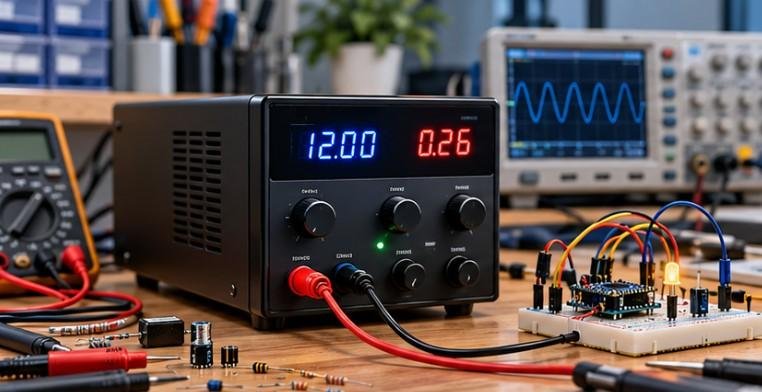
While an oscilloscope helps visualize signal behavior over time, a multimeter remains essential for checking voltage, continuity, and resistance in Arduino-based circuits.
For makers building sensor-driven prototypes or troubleshooting microcontroller connections, this resource to the best multimeter for Arduino projects and beginners can help identify a suitable tool for everyday electronics testing.
In contrast, deep-memory scopes maintain maximum resolution across the entire capture window, pinpointing narrow ringing spikes that slip past shallow buffers.
Top Budget Digital Oscilloscopes for Robotics Builders
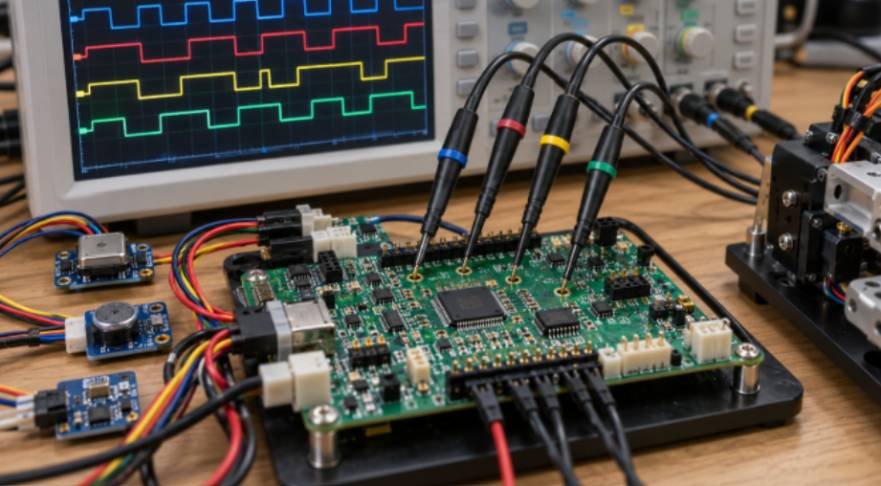
Each model serves a different stage of prototyping, balancing form factor, channel density, and field portability.
Rigol DS1054Z: The 4-Channel Bench Benchmark
The Rigol DS1054Z remains the gold standard for robotics hobbyists. Having four independent analog channels makes it the premier choice for debugging multi-sensor assemblies, robotic drivetrains, and complementary PWM gate drives.
- Four analog channels allow simultaneous monitoring of microcontroller control pins, gate drivers, and sensor return lines.
- 24 Mpts memory depth lets you freeze long communication frames and zoom into individual bit edges without resolution loss.
- Native I2C, SPI, and UART protocol decoding decodes hexadecimal data right on the screen.
The cooling fan produces a persistent low hum, and the interface menus feel layered, but its measurement stability and massive user community support make it the benchmark workbench scope.
ZOYI ZT-703S: The Mobile Field Repair Hybrid
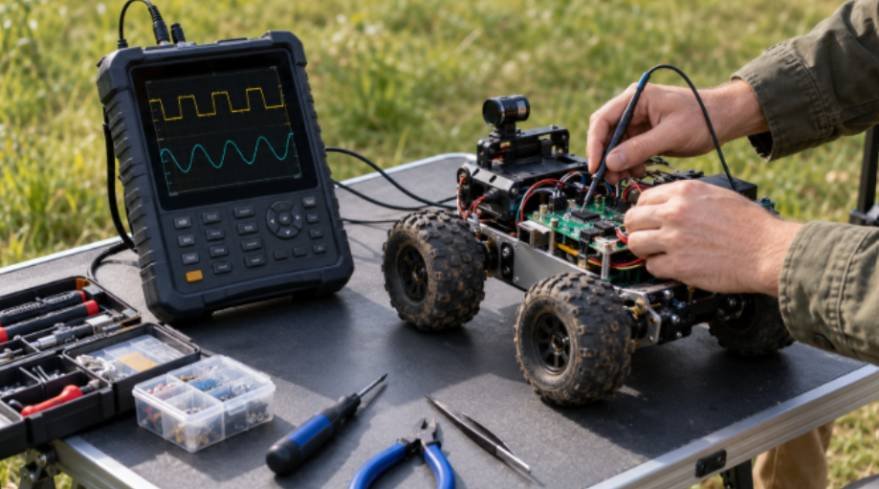
Combat robotics pits and outdoor rover testing lack convenient AC wall outlets. The ZOYI ZT-703S solves this problem by combining a true 2-channel 50 MHz oscilloscope with a 25,000-count digital multimeter inside a rugged, battery-powered shell.
- Integrated 18650 lithium power provides three to four hours of wireless troubleshooting directly on the turf or test arena.
- Dual channels allow differential signal monitoring across brushed motor terminals without dangerous ground loops.
- A single button press toggles between high-precision DC resistance/voltage measurements and real-time waveform inspection.
Its shallow memory buffer cannot store extensive serial data streams, but for rapid diagnostics away from the bench, its portability proves indispensable.
Hantek DSO5102P: Bare-Bones Raw Bandwidth
If your budget caps out strictly under $250 and your focus centers on basic analog circuits, high-speed crystal oscillators, or simple motor drivers, the Hantek DSO5102P offers high raw bandwidth per dollar.
- Native 100 MHz bandwidth captures fast square-wave rise times up to roughly 20 MHz fundamental frequencies cleanly.
- Dedicated physical knobs for vertical scale and horizontal timebases simplify navigation for beginners.
- The lightweight chassis integrates cleanly into compact hobby workspaces.
The unit lacks hardware protocol decoding, and its 40 Kpts buffer limits deep signal capture. However, for basic two-point analog motor circuit verification, it provides solid, accessible performance.
US Sourcing, Distributor Logistics, and Warranty Protection
Test equipment requires reliable customer support and honest warranty coverage. Sourcing budget oscilloscopes through domestic US distribution channels (such as authorized Amazon storefronts, Newark, or Mouser) safeguards your investment.
Direct purchases shipped from overseas platforms often involve lengthy transit times and complex return logistics if a channel arrives damaged. Major brands like Rigol maintain official domestic support branches in the United States, honoring factory repair guarantees and offering replacement passive probes. Ensuring local supply access shields you from grey-market listings that omit calibrated safety accessories.
Integrating Test Equipment with a Clean Workbench
An oscilloscope functions as one pillar of a reliable electronics assembly workspace. Signal integrity depends heavily on clean mechanical connections, low-impedance ground bonding, and high-quality wiring harnesses.
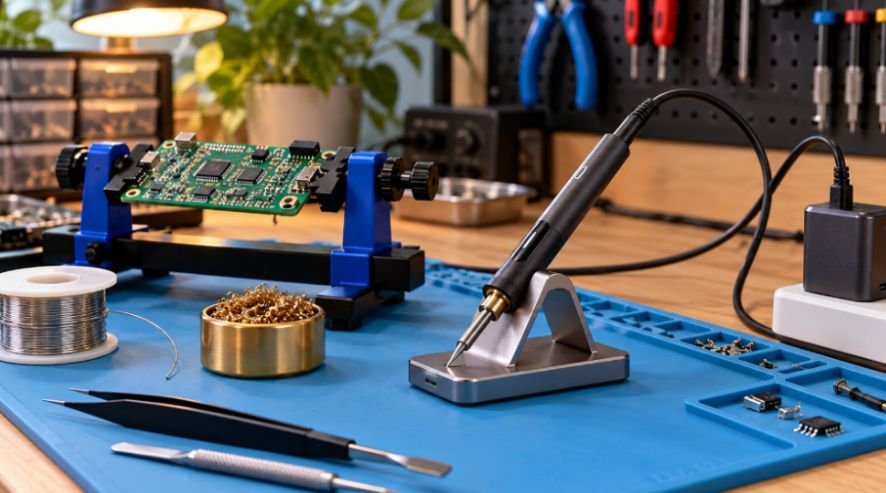
Reliable signal analysis starts with properly assembled circuits and dependable solder joints. Choosing the best portable soldering station for an electronics workbench helps robotics makers build durable wiring connections, repair motor driver boards, and rework sensor circuits with consistent temperature control.
As highlighted in NASA Wire and Signal Fault Identification reports, cold solder joints and fractured wires represent the leading cause of intermittent robotics communication failures. Maintaining temperature-regulated, ESD-safe assembly gear ensures your clean scope traces reflect deliberate circuit design rather than damaged connections.
Frequently Asked Questions
1. How many oscilloscope channels do I need for hobby robotics?
Four channels are ideal because they allow you to monitor full SPI communication buses, quadrature encoders, and complementary motor phases simultaneously.
2. Is 50 MHz bandwidth enough for microcontroller robotics projects?
Yes, 50 MHz easily handles standard motor PWM, SPI buses up to 10 MHz, and fast I2C communication without signal attenuation.
3. Can an oscilloscope decode serial data like UART and I2C?
Scopes with integrated protocol analyzers decode serial bus data into legible binary or hexadecimal packets directly on screen.
4. Why do I see high-frequency ringing on my motor driver gate signals?
Ringing is caused by parasitic PCB inductance oscillating with MOSFET gate capacitance, which an oscilloscope reveals instantly.
Stop Probing Blindly, Build Confidently
Relying on digital multimeters to diagnose erratic motor drives and dropped sensor packets leaves you guessing in the dark. Equipping your workspace with a capable digital oscilloscope exposes high-frequency noise, catches ground bounce, and validates serial communications in real time.
Choose a four-channel bench unit like the Rigol DS1054Z for detailed system prototyping, or keep a compact hybrid like the ZOYI ZT-703S in your toolbox for mobile field repairs. Pinpoint your hardware faults visually, solder down solid joints, and spend your build hours creating functional robotics rather than chasing phantom glitches.