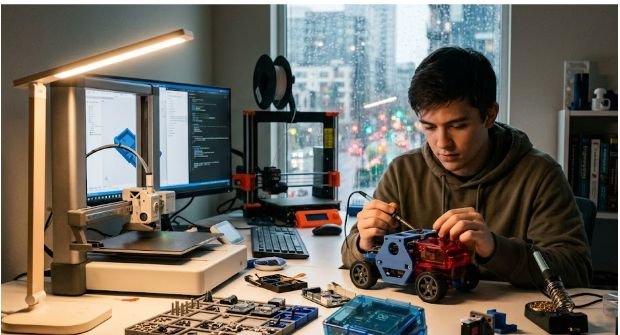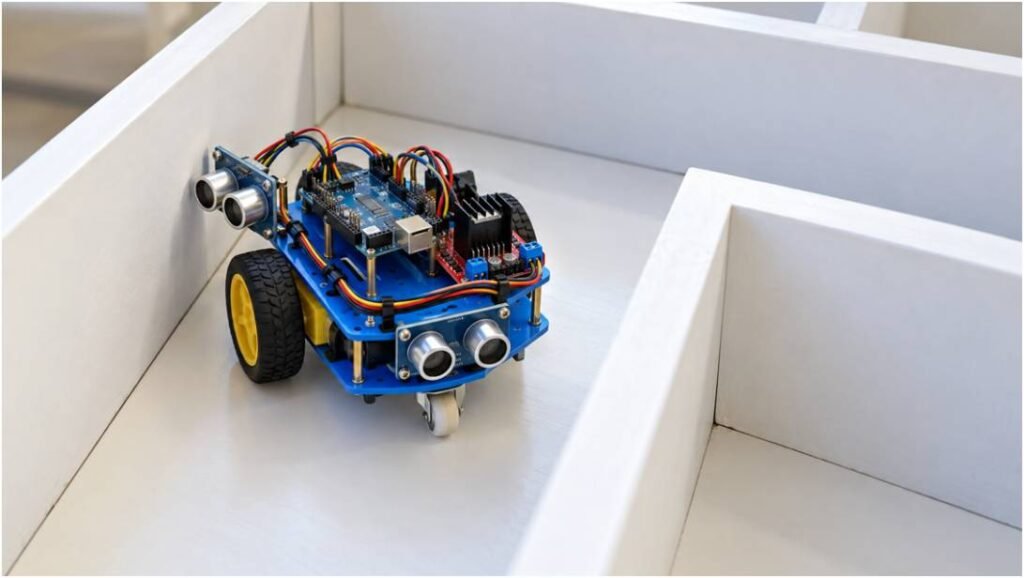

A robot rolling toward a workbench can turn an ordinary test into an urgent problem. When I assess a robotics project, I want to know how someone can stop hazardous movement without searching through menus. That practical concern explains why robots need emergency stop buttons: people need an accessible way to intervene when unexpected behavior creates danger.
Whether you work in a school robotics lab, garage workshop, or manufacturing facility, an emergency stop supports safer operation. Its effectiveness depends on the complete stopping system, including its controls, placement, and recovery procedure.
What Does a Robot Emergency Stop Actually Do?
An emergency stop initiates a designed safety function when someone recognizes an emergency. Depending on the machine, that function may remove drive power immediately or first bring movement under control before removing power.
The familiar red button is only the interface. Behind it, appropriate safety components process the signal and initiate the required response.
An emergency stop also remains latched until someone intentionally resets it. Releasing the button must not automatically restart the robot. That separation gives operators an opportunity to investigate the problem before movement becomes possible again.
Why Human Intervention Still Matters

Robots follow commands and respond to inputs, but unexpected conditions can develop outside their intended operation. A shifted workpiece, damaged cable, programming mistake, or unstable load can create hazards.
Someone nearby may recognize the problem before an automated protective function responds. Understanding why robots need emergency stop buttons means recognizing the value of that human intervention alongside engineered safeguards.
Effective robotic safety depends on understanding how sensing and actuation work together within the control system. Sensors detect environmental changes and provide information about potential hazards, while actuators execute physical movements in response to control signals.
A thorough understanding of the differences between sensors and actuators in robotics clarifies their respective roles in detecting abnormal conditions and controlling mechanical responses, reinforcing the importance of integrating appropriate safeguards into robot design.
Reducing Harm From Unexpected Movement
A mobile robot might move toward someone’s feet. A robotic arm might approach a misplaced fixture. An emergency stop gives an observer a direct way to request emergency stopping.
It cannot guarantee that contact will be avoided. Speed, payload, braking performance, and stopping distance determine how much movement occurs after activation.
Limiting Equipment Damage
An emergency stop may also reduce damage when a robot jams, approaches an obstruction, or moves incorrectly. Protecting equipment matters, but personnel safety takes priority. Operators should never reach into hazardous motion to save a component.
Why a Normal Stop Command Is Different
A screen button or keyboard command typically depends on ordinary control software and communication. If that path freezes or fails, the stop request may not produce the expected response.
An emergency-stop function requires an appropriately designed safety control path. Industrial systems may use safety relays, safety controllers, monitored circuits, or safety-rated communication.
The appropriate safety measures also depend on whether a robot operates independently or receives instructions from a human operator. Autonomous systems use programmed logic and sensor inputs to perform tasks with varying degrees of independence, while teleoperated systems rely on remote human control.
Understanding the key differences between autonomous and teleoperated robots helps clarify how control architectures influence operator involvement, response requirements, and the design of dependable emergency-stop mechanisms.
For classroom and hobby projects, an ordinary microcontroller input does not become a dependable emergency-stop system simply because the attached button is red. The design must address the robot’s actual hazards and foreseeable failures.
Emergency Stops and Protective Stops Serve Different Purposes
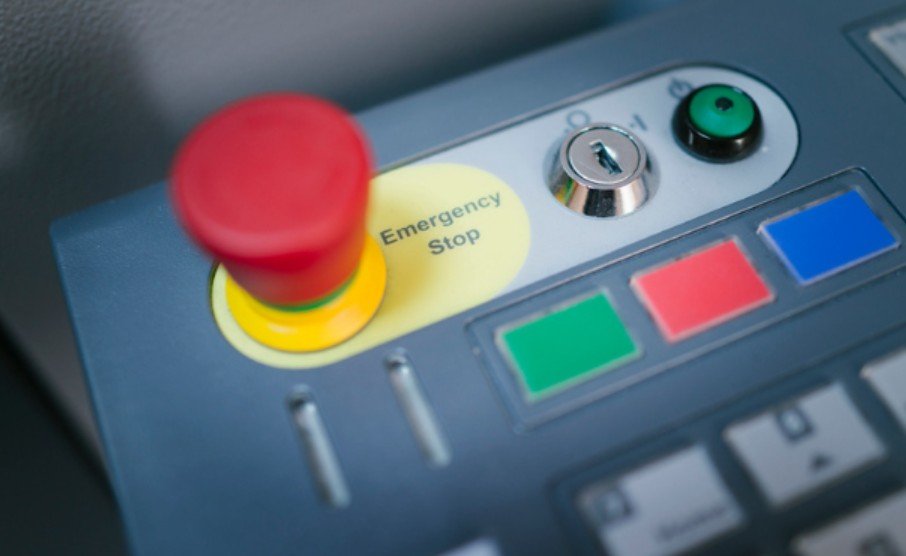
An emergency stop usually begins with a person recognizing an abnormal situation and taking action.
A protective stop can begin automatically when a protective device detects a condition requiring intervention. Examples include an opened interlocked guard or intrusion into a safety scanner’s protective field.
Both functions matter, but their intended use and recovery behavior differ. Emergency stops should not become everyday pause buttons. Routine stopping belongs to the robot’s normal operating controls.
Why Stopping Does Not Always Mean Cutting Power Immediately
Removing power sounds straightforward, but the safest stopping response depends on the machine.
A Category 0 stop removes actuator power immediately. A Category 1 stop uses power to achieve controlled stopping before removing it. An emergency-stop function uses the appropriate approach based on the application.
Gravity, momentum, suspended loads, and stored pneumatic energy complicate the decision. Stopping a robot must avoid introducing additional hazards, such as dropping a held object. A competent risk assessment determines the required response.
Reliable emergency-stop performance depends on a power system capable of supporting the robot’s electrical loads while responding appropriately to demanding operating conditions. Insufficient current capacity, excessive voltage drop, or unstable power delivery can compromise component performance and contribute to unexpected behaviour.
Developing a comprehensive power budget for a robot helps identify electrical limitations, evaluate peak demand, and improve overall system reliability as part of a broader safety-focused design.
Button Placement, Testing, and Safe Recovery
Emergency-stop devices must be recognizable and reachable without requiring someone to enter danger. Operator stations, loading areas, and other interaction points deserve particular attention.
A button hidden behind equipment or mounted on an inaccessible side may provide little practical help.
Inspection and functional testing should follow the manufacturer’s instructions and the application’s risk assessment. Checks should cover the stopping response and confirm that resetting does not initiate movement.
After activation, identify the cause, address the hazard, and verify that people are clear before following the approved restart procedure. An emergency stop does not replace energy isolation for servicing.
Frequently Asked Questions
1. Can an emergency stop prevent every robot accident?
No. Explaining why robots need emergency stop buttons also requires explaining their limits. They complement safe design, guarding, protective devices, training, and controlled access.
2. Should small educational robots have one?
Their stopping arrangements should reflect their hazards. Lightweight robots and powerful student-built machines present different risks. Size alone does not determine the necessary protection.
3. Does pressing the button remove every hazard?
No. Electrical energy, compressed air, hot surfaces, gravity, and stored mechanical energy may remain. A stopped robot is not automatically safe to service.
4. Is a deadman switch the same thing?
No. An enabling device permits specified operation under defined conditions. Its purpose and behavior differ from a manually activated emergency stop.
Final Thoughts
I consider a dependable stopping system an essential part of responsible robot design. Before focusing on speed, payload, or advanced features, I want to know whether someone can reach the emergency stop, how the robot will respond, and what hazards may remain afterward. Those questions matter in a classroom, garage workshop, or production facility.
A visible red button only helps when the safety system behind it works as intended. Accessible placement, appropriate testing, clear operator training, and a deliberate restart procedure all contribute to its effectiveness. I would also keep emergency stopping separate from routine pauses and follow proper energy-isolation procedures before servicing equipment.