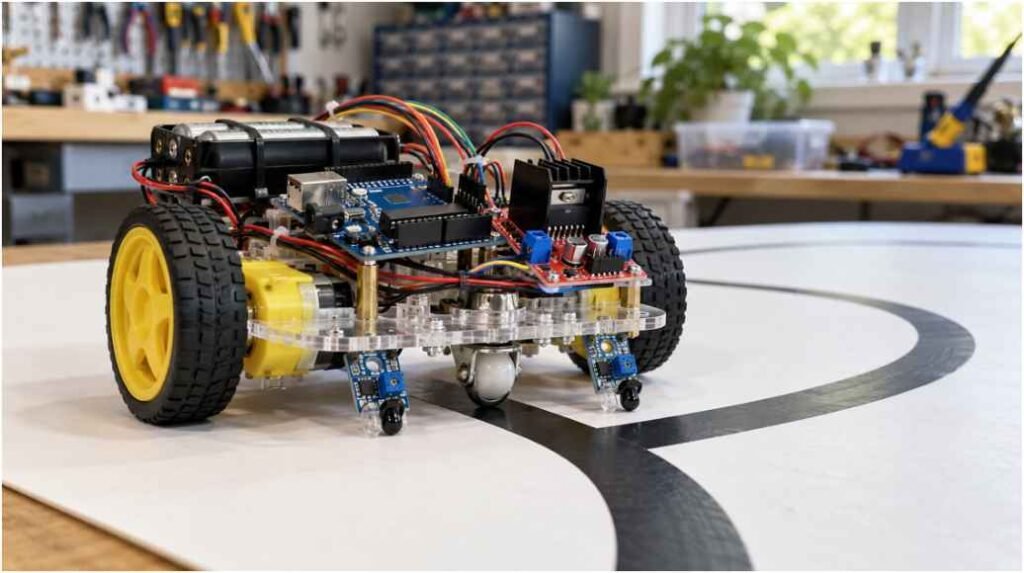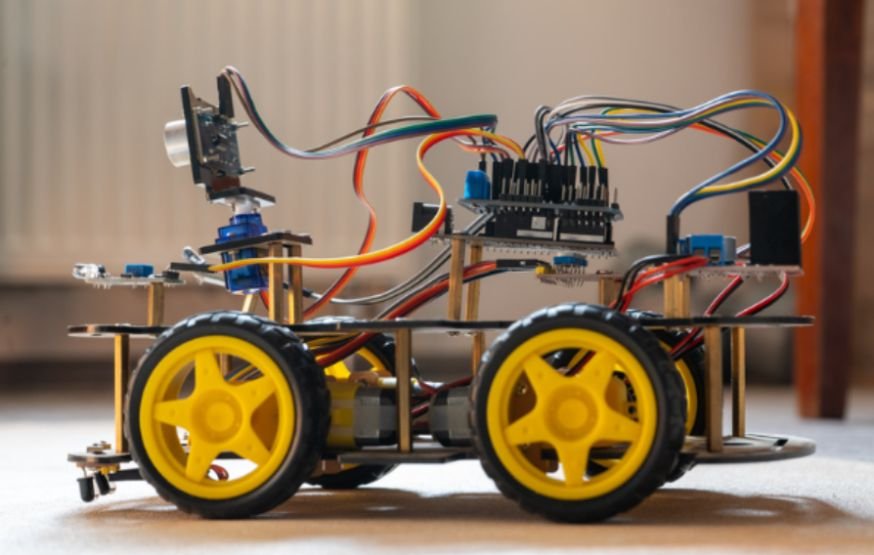
I would check the wheels before rewriting code for a robot that struggles on carpet or overshoots its stopping point. Understanding how wheel diameter affects robot movement helps explain why a simple wheel swap can improve one behavior while making another worse.
Bigger wheels cover more ground per revolution, but they also demand more torque to deliver the same pushing force. Whether you build a classroom rover, competition robot, or backyard explorer, matching wheel size to your drivetrain makes movement more predictable.
Why Wheel Circumference Changes Travel Distance
A wheel moves the robot forward by approximately its circumference during each complete revolution, assuming it rolls without slipping.
Circumference equals π multiplied by diameter. A 60 mm wheel therefore travels approximately 188.5 mm per revolution, while a 120 mm wheel travels about 377 mm.
Doubling diameter doubles theoretical travel per revolution. However, it does not automatically double real driving speed. The motor must maintain its rotational speed while carrying the robot and overcoming resistance.
Calculate Speed From Wheel RPM
Calculate theoretical speed in meters per second by multiplying wheel RPM by π and diameter in meters, then dividing by 60.
At 100 wheel RPM, a 60 mm wheel produces approximately 0.314 meters per second. A 120 mm wheel produces approximately 0.628 meters per second.
Use wheel RPM after gearing, rather than the motor’s shaft RPM before the gearbox. Otherwise, your estimate can be substantially wrong.
How Diameter Changes Pushing Force and Acceleration
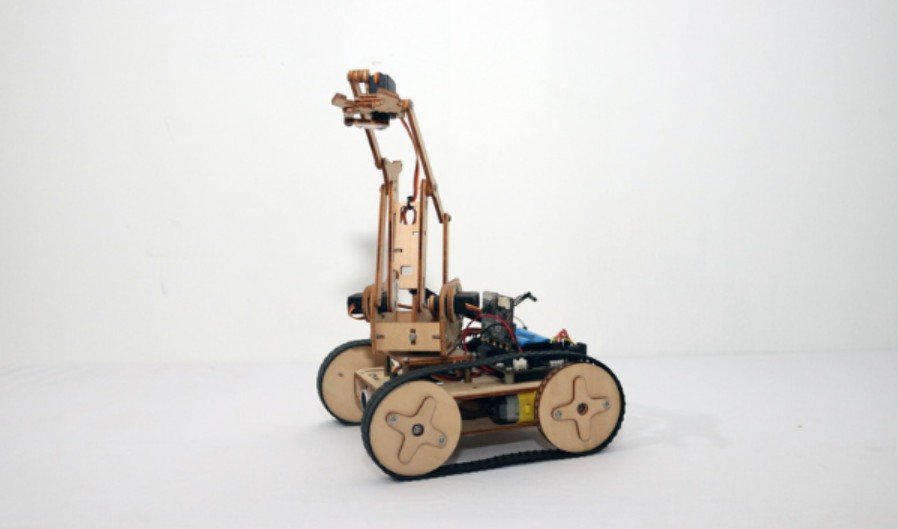
Wheel torque becomes forward force at the ground. The basic relationship is force equals wheel torque divided by wheel radius.
For robots designed to manipulate objects as well as move them, drivetrain performance is only one part of the mechanical equation. The end-effector must also generate sufficient gripping force, maintain precise contact, and handle the intended payload without compromising stability.
Understanding the different types of robotic end effectors can help you select an appropriate gripping or handling mechanism that complements the robot’s mobility, torque capacity, and application requirements.
With 0.3 newton-meters of torque, a wheel with a 30 mm radius theoretically produces 10 newtons of force. Increase the radius to 60 mm, and that force falls to 5 newtons.
The larger wheel has not reduced gearbox output torque. It has changed how that torque translates into ground force.
Why Smaller Wheels Can Start More Quickly
Smaller wheels can provide stronger acceleration when wheel torque, robot mass, and traction remain comparable. This helps during frequent starts, short movements, and pushing tasks.
Larger wheels may also add rotational inertia, depending on their mass and construction. Motors must accelerate the wheels as well as the chassis.
Actual acceleration still depends on tire grip, available current, gearing, and motor characteristics. A small wheel that spins on a slippery floor cannot use all its theoretical pushing force.
What Happens on Ramps and Rough Ground
Larger wheels generally approach small obstacles more favorably and can increase ground clearance when axle mounting remains unchanged. This helps a rover cross floor transitions, cables, or uneven paving.
However, clearance alone does not guarantee climbing ability. A large wheel paired with an undersized motor may stall against an obstacle.
Ramps introduce another demand: the drivetrain must overcome the component of gravity pulling the robot downhill. Increasing wheel radius increases the torque required to produce a given climbing force.
When evaluating how wheel diameter affects robot movement, consider obstacles and slopes separately. Larger wheels may help with an obstacle’s geometry while making sustained uphill driving harder for the same drivetrain.
Why Bigger Wheels Do Not Guarantee Better Traction
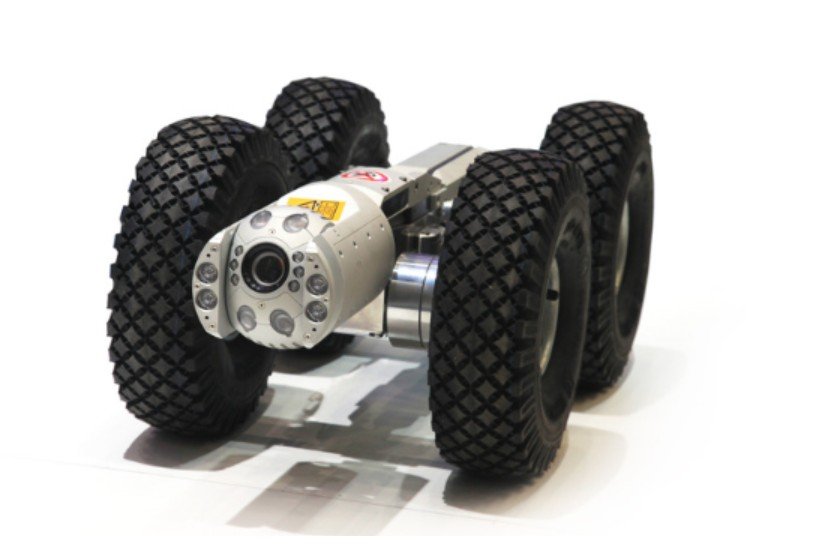
Traction depends on tire material, surface condition, tread, and the load carried by driven wheels. Diameter alone cannot tell you how firmly a robot will grip.
A smaller rubber wheel may outperform a larger hard plastic wheel on smooth flooring. On loose ground, wheel width, tread design, and sinkage also matter.
Turning introduces another tradeoff. High-grip tires can resist sideways scrubbing on skid-steer robots, increasing turning effort. Omni wheels and mecanum wheels behave differently because their rollers permit movement in additional directions.
How Wheel Size Changes Stability and Accuracy
Larger wheels can raise the chassis and its center of mass.
When evaluating a robot’s stability and movement precision, it is also important to consider how its mechanical configuration determines the directions and types of motion it can perform. A robot’s axes and degrees of freedom influence its ability to navigate, orient itself, and manipulate objects within a workspace.
Understanding robot axes and degrees of freedom provides valuable context for designing a chassis and motion system that meet the demands of the intended application.
Depending on the design, this can reduce the tipping margin during turns or on slopes. Keep batteries and heavy payloads low.
Wheel changes also affect encoder calculations. Software converts wheel rotations into distance using an assumed circumference. An incorrect diameter creates a systematic distance error.
Unequal effective diameters can make a differential-drive robot drift even when both wheels turn at matching rates. Tire wear, compression, and manufacturing differences can contribute.
After a wheel swap, measure actual travel over a known distance and repeat the test.
Accurate wheel calibration becomes even more valuable when deciding how a robot should correct deviations from its intended path.
Open-loop control relies on predefined commands without measuring the resulting movement, whereas closed-loop control uses feedback from encoders or other sensors to adjust performance in response to actual results.
Understanding the key differences between open-loop and closed-loop robotics can help you determine which control strategy offers the precision, consistency, and adaptability your robot requires.
Adjust the configured diameter using measured results rather than relying entirely on nominal sizing.
Frequently Asked Questions
1. What is the simplest explanation of how wheel diameter affects robot movement?
Larger wheels travel farther per revolution but require more torque for the same ground force. Smaller wheels provide more ground force at equal wheel torque, with less travel per revolution.
2. Should I change gearing when installing larger wheels?
Check your required speed and torque. Increasing gear reduction can restore pushing force, although it lowers wheel RPM. Confirm motor and gearbox operating limits before testing under load.
3. Can smaller wheels improve battery life?
Sometimes, if they help the motor operate efficiently for the task. Battery life also depends on gearing, speed, terrain, payload, and driving behavior, so diameter alone cannot predict runtime.
Make the Wheel Swap Count
I would choose wheel diameter around the robot’s toughest task, whether that means crossing uneven ground, carrying a payload, or stopping accurately. Larger wheels can improve clearance and travel farther per revolution, while smaller wheels can deliver more pushing force at the same wheel torque. The better choice depends on how those benefits fit your motors, gearing, chassis, and driving surface.
Before committing to a new size, I would test acceleration, climbing, turning, and stopping with the full payload installed. I would also recalibrate encoder distance settings and watch for wheel slip or excessive motor heating. Changing one variable at a time makes the results easier to interpret. A successful wheel swap should deliver repeatable movement throughout the intended route, with enough drivetrain capacity to handle demanding sections reliably.