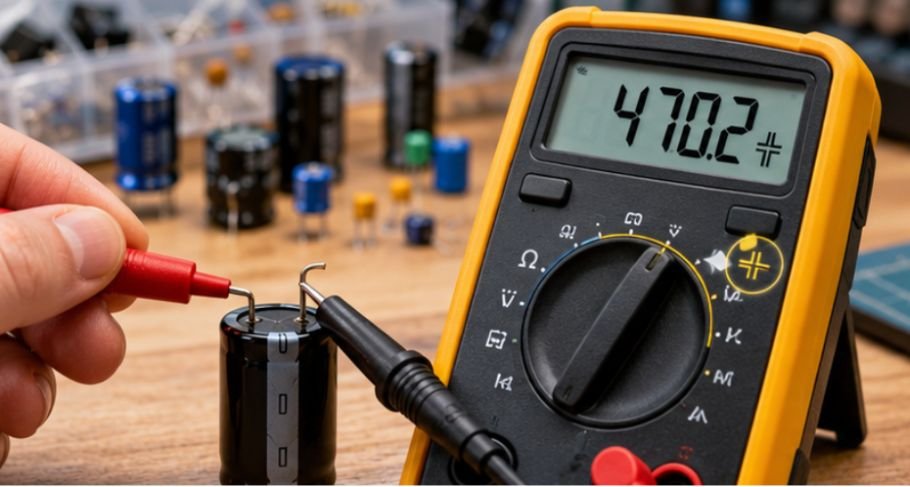
A multimeter can display a capacitor value and still tell you only half the story. That distinction matters for makers troubleshooting Arduino power rails, repairing old electronics, checking motor capacitors, or sorting components pulled from a parts bin.
For this digital multimeter with capacitance test review for makers, I focused less on feature-count marketing and more on the measurements that are useful at a US electronics bench: capacitance range, low-value resolution, measurement speed, safety protection, True RMS capability, and whether the meter can realistically replace a separate capacitance tester.
The short answer is that affordable meters have become remarkably capable, but the best choice depends heavily on what you build.
Why Capacitance Testing Deserves More Attention
Capacitance describes how much electric charge a component can store for a given voltage. OpenStax expresses the basic relationship as C = Q/V and notes that practical capacitor values can range from picofarads through millifarads.
That huge range creates the first problem for makers: a meter that works well on a 470 µF electrolytic may be much less useful for a 100 pF ceramic capacitor.
Digital multimeters generally measure capacitance by applying a controlled charging process and calculating the value from the electrical response. A Fluke technical manual hosted by UC San Diego explains this charging-and-measurement method and also recommends relative mode for very small capacitors because the meter and test leads contribute capacitance of their own. That is why simply seeing a capacitance symbol on the selector dial is not enough.
Five Multimeters Makers Are Likely to Encounter
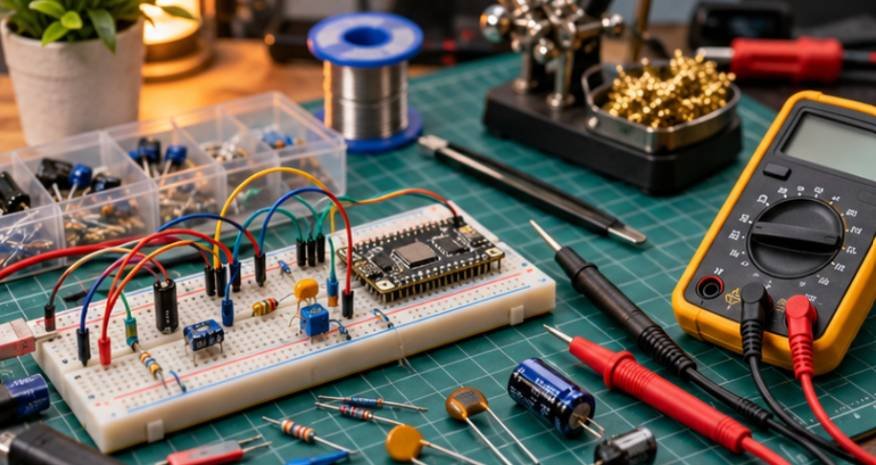
AstroAI 6000-Count: Strong Feature Value for the Workbench
AstroAI’s 6000-count meter is one of the more interesting inexpensive choices because its published manual gives it a capacitance range from 60 nF through 20 mF. Its finest listed resolution is 10 pF on the 60 nF range, while larger ranges progressively trade resolution for capacity.
That is a useful spread for breadboards, Arduino projects, power-supply experiments, electrolytics, and general component sorting. AstroAI also includes frequency measurement, temperature, transistor testing, auto/manual ranging, and replaceable fuses. Its manual lists CAT III 600 V and CAT II 1000 V compliance.
There is a catch: the specified capacitance accuracy is ±(8% + 5 digits). That is acceptable for identifying whether a nominal 470 µF capacitor is somewhere near its expected value, but less attractive for precision component characterization.
For hobby electronics, value often matters more than laboratory-grade accuracy, making this a sensible general-purpose choice.
Klein Tools MM450: Better Daily Usability, Smaller Capacitance Ceiling
The Klein Tools MM450 takes a different approach. It is a compact 4,000-count True-RMS meter with auto-ranging, temperature, frequency, duty-cycle, diode and continuity testing. Its capacitance range tops out at 400 µF.
That limit matters. It comfortably covers many timing, filtering, and bypass components, but makers frequently encounter 470 µF, 1,000 µF, 2,200 µF, and larger electrolytics in power supplies and motor-control projects.
The reason to choose the Klein is instead the overall package. Its reverse-contrast display, optical ambient-light sensing, slim housing, lead-alert system and CAT III 600 V rating make it particularly attractive for someone who moves between electronics projects, automotive troubleshooting, and household electrical work.
If your priority is broader multimeter usability rather than maximum capacitor range, it makes a strong case.
Fluke 115: The Reliability-First Upgrade
The Fluke 115 costs dramatically more than typical maker meters, but its specifications explain part of the premium.
It measures from 1 nF up to 9,999 µF, with Fluke specifying capacitance accuracy of 1.9% + 2 counts through much of the range. Values above 1,000 µF receive a looser specification. The meter is also True RMS, 6,000-count and CAT III 600 V rated.
For makers, the appeal is not that it unlocks exotic functions. The appeal is confidence in the basic functions, construction and documented specifications.
A hobbyist building occasional Arduino circuits probably does not need to spend Fluke money. Someone repairing equipment every week, working around higher-energy circuits, or depending on one meter professionally may see the equation differently.
AMES DM300: Impressive Capability in a Pocket Meter
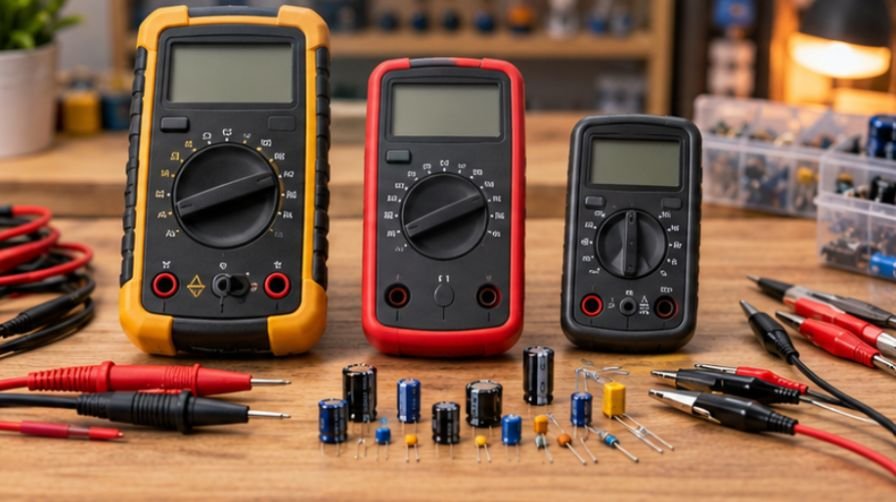
The AMES Instruments DM300 is easy to underestimate. Harbor Freight currently lists the compact autoranging meter with capacitance measurement up to 100 µF, frequency up to 100 kHz, resistance to 40 MΩ, continuity, diode testing and CAT III 300 V protection. Its specified capacitance accuracy is ±3% of reading plus three digits.
For quick bench checks, toolboxes and portable Arduino kits, that combination is compelling. The disadvantage is the 100 µF ceiling. It is suitable for many small capacitors but quickly runs out of range once you begin diagnosing power-supply electrolytics.
What About the Crenova MS8233D?
This is where checking specifications rather than search summaries pays off. Some comparison material associates the Crenova MS8233D with capacitance testing. However, Crenova’s published MS8233D documentation lists voltage, current, resistance, frequency, diode and continuity measurements without presenting a capacitance function.
I therefore would not buy this specific model specifically for capacitor testing without confirming the exact revision and seller documentation first.
That is a useful rule for every budget meter: model names and revisions can look nearly identical while functions differ.
My Maker-Focused Comparison
| Meter | Capacitance capability | Best fit |
| AstroAI 6000-count | 60 nF to 20 mF | Budget electronics bench |
| Klein MM450 | Up to 400 µF | Mixed electrical and maker work |
| Fluke 115 | 1 nF to 9,999 µF | Serious troubleshooting and professional use |
| AMES DM300 | Up to 100 µF | Portable basic testing |
| Crenova MS8233D | Verify before buying | Not my choice specifically for capacitance |
For Arduino-oriented work, measurement convenience can matter as much as maximum range. Makers building sensor circuits and low-voltage prototypes may also benefit from choosing the best multimeter for electronics beginners to measure voltage, check continuity, and troubleshoot basic circuit connections.
The Bench Test I Would Use Before Trusting Any Meter
A good digital multimeter with capacitance test review for makers should include more than reading specifications. I would test a new meter against three known capacitors: roughly 100 nF, 10 µF and 470 µF.
First, remove the capacitor from the powered circuit. Discharge it safely and verify near-zero voltage with the meter before switching to capacitance mode.
MIT laboratory material similarly instructs students to ensure a capacitor is discharged before measurement, while the University of Colorado Boulder specifically warns that capacitors can retain dangerous energy after power is removed.
Then measure each capacitor three times. Watch for repeatability, settling time and whether the lowest-value component changes significantly when you reposition the test leads.
When assembling reliable electronics prototypes, secure wire connections are just as important as accurate measurements. Choosing the best wire crimping tool for JST and Dupont connectors helps makers create dependable connections for Arduino circuits, sensor modules, and other low-voltage projects.
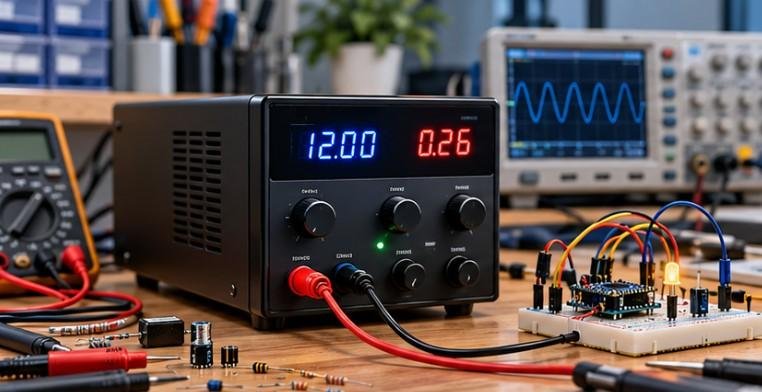
Reliable capacitor testing also depends on a stable, adjustable power source when evaluating components in electronics prototypes. An adjustable benchtop DC power supply for an electronics lab helps makers control voltage during circuit testing and troubleshoot Arduino boards, power-regulation circuits, and other low-voltage projects.
For small values, use REL or zero mode if available.Lead capacitance that is trivial beside 100 µF can become a meaningful portion of a tiny nanofarad reading.
Finally, compare the result with the component’s tolerance, not merely the printed nominal value. A 100 µF capacitor rated ±20% does not automatically become defective because your meter reads 91 µF.
Capacitance Is Not the Same as Capacitor Health
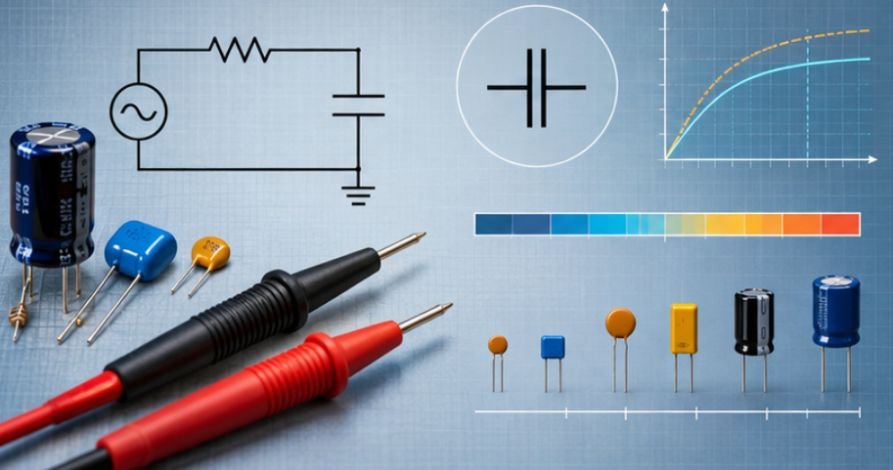
This is the most important limitation of the feature. A standard DMM usually tells you approximately how much capacitance remains. It does not necessarily tell you whether an electrolytic capacitor has developed excessive equivalent series resistance, or ESR.
A capacitor may therefore read close to its marked microfarad value and still perform badly under ripple current or switching conditions.
For repairing switching power supplies, vintage audio equipment, motherboards or other electronics where aging electrolytics are common, an ESR meter or LCR meter becomes a useful companion rather than a redundant purchase.
Do Not Treat “Discharged” as an Assumption
Capacitors store energy after power is removed. OSHA’s guidance for high-capacitance electrical equipment specifically requires stored energy to be discharged through an appropriately rated resistor before grounding.
UC Berkeley’s Environment, Health & Safety office similarly advises verifying capacitor voltage with a suitable voltmeter and using correctly rated resistive discharge equipment where necessary.
For normal low-voltage maker projects, the energy involved is often modest. Power supplies, microwave circuitry, high-voltage amplifiers, mains-connected equipment and large capacitor banks are different territory.
Frequently Asked Questions
1. Is capacitance mode accurate enough for electronics projects?
Usually, yes. It is excellent for identifying values, checking tolerances and spotting seriously degraded capacitors, provided the capacitor falls within the meter’s stated range.
2. Can I measure a capacitor while it is still in the circuit?
Sometimes, but nearby components can distort the reading. For dependable results, disconnect at least one capacitor lead from the circuit after safely removing power and discharging it.
3. Do I still need an ESR meter?
For ordinary maker work, probably not. For diagnosing aging electrolytic capacitors in power supplies, audio gear and switching electronics, ESR testing can reveal failures that capacitance alone misses.
4. Is a higher capacitance range always better?
No. Resolution, accuracy, measurement speed, safety rating and build quality matter too. A 20 mF range has little value if most of your projects involve tiny ceramic capacitors.
The Meter I Would Put on a Maker Bench
The best digital multimeter with capacitance test review for makers result is not simply the model with the longest specification list. For a budget workbench, the Astro AI offers unusually broad capacitance coverage. The Klein MM450 makes more sense when everyday usability and mixed electrical work matter. The Fluke 115 is the stronger long-term choice for demanding troubleshooting, while the AMES DM300 works well as a compact secondary meter.
The bigger lesson is simple: capacitance mode is incredibly useful, but it should be treated as one diagnostic clue. Check the measurement range, understand capacitor tolerance, respect stored energy, and know when ESR testing is the missing piece.