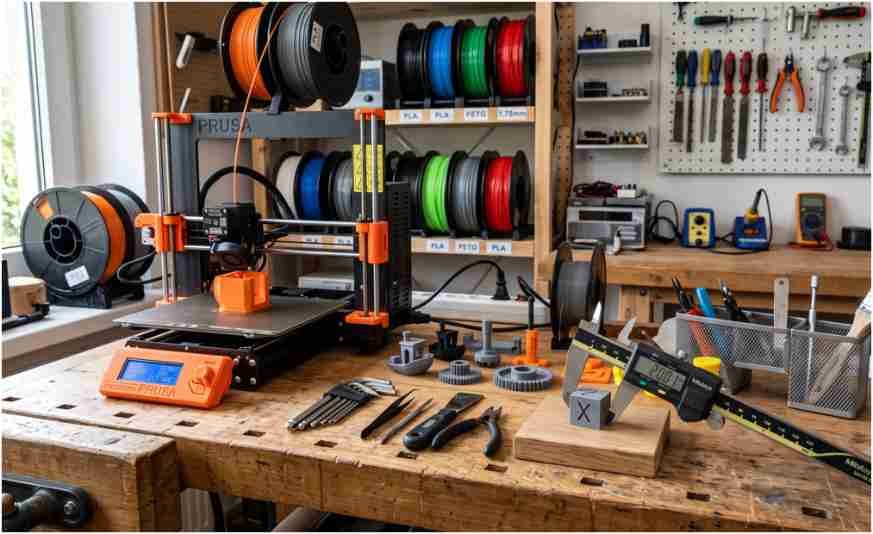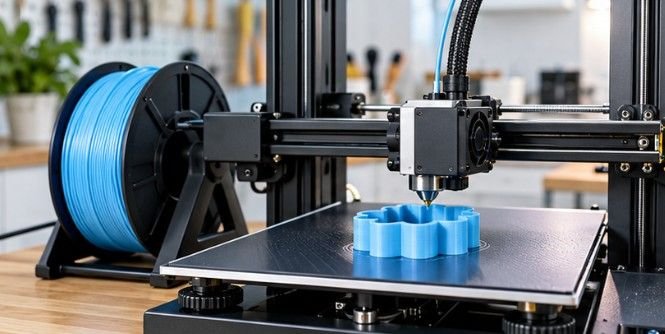
A spool labeled “food-safe PLA” does not automatically produce a food-safe object. That distinction is the most important thing to understand about food safe 3d printing guidelines. In the United States, food-contact safety depends not only on the base polymer, but also on additives, printing hardware, surface condition, temperature, cleaning method, and how the finished object will touch food.
A filament may use a polymer that is permitted for certain food-contact applications while the finished print still contains microscopic crevices, contamination from the printer, or pigments and coatings that were never evaluated for the intended use. For kitchen projects, the question should therefore be: Is the entire finished object suitable for this specific type of food contact?
“Food-Safe Filament” and a Food-Safe Print Are Not the Same Thing
The FDA distinguishes between a food-contact substance, a food-contact material, and the finished food-contact article. That matters enormously for 3D printing.
A polymer can have an authorized food-contact use, but authorization depends on its identity, intended application, and conditions of use. The FDA specifically notes that inclusion in its food-contact inventory does not mean a substance is acceptable for every possible application.
You can review the FDA’s food-contact resources here:
For a home 3D printer, several additional variables enter the equation:
- pigments and processing additives in the filament
- residues from previously printed materials
- wear particles from the nozzle
- microscopic gaps between extrusion lines
- adhesives or sprays used on the print bed
- sanding compounds and polishing materials
- sealants or epoxy coatings
- heat, acidity, fat content, and contact time of the food
That is why simply seeing “PLA,” “PETG,” or “PP” on a spool is not enough.
The Biggest Problem Is Often the Surface, Not the Polymer
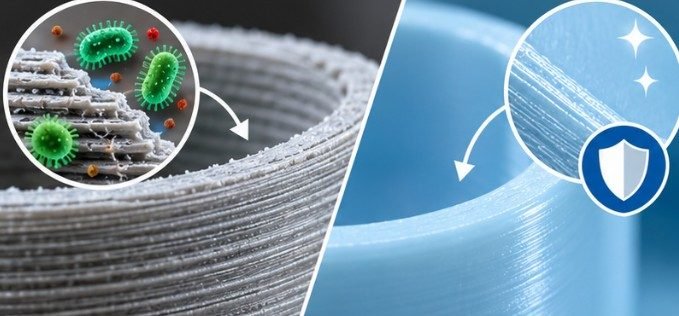
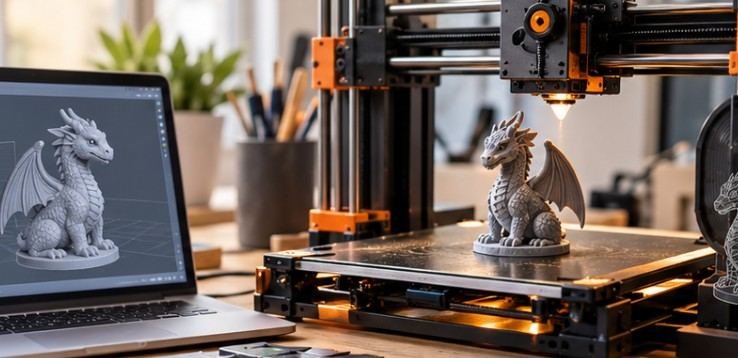
Fused-filament fabrication creates an object by depositing hundreds or thousands of adjacent lines of molten plastic. Even a print that looks smooth to the eye contains seams, valleys, pores, and irregularities.
Those features matter because safe reusable food-contact equipment is expected to have smooth, durable, nonabsorbent surfaces that can be effectively cleaned.
USDA FSIS Sanitation Performance Standards says multiuse food-contact surfaces should be smooth, easily cleanable and free of cracks, open seams, pits, chips, and similar imperfections. That standard explains why a rough FDM cup used every morning presents a different risk than a cookie cutter touching dough for 30 seconds.
A cookie cutter can be washed immediately and has limited food contact. A reusable drinking cup repeatedly encounters moisture, saliva, detergents, temperature changes, and long periods in which microbial growth may occur.
Which 3D Printing Materials Are Better for Food Contact?
No filament should be considered universally food-safe simply because of its polymer name. Specific formulations matter.
Still, some materials are easier to justify for food-contact projects than others.
| Material | Practical food-contact considerations |
| PLA | Easy to print but has relatively poor heat resistance and may deform during hot washing |
| PETG | Better moisture and temperature resistance than standard PLA, but surface cleanability still matters |
| Polypropylene | Commonly used in food containers and resistant to many chemicals, although difficult to print reliably |
| Nylon | Durable but may absorb moisture; formulation and intended use must be verified |
| Resin prints | Require particular caution because uncured resin and incomplete post-curing can create chemical-exposure concerns |
Oklahoma State University Extension has published specific guidance on 3D-printed food-contact parts and emphasizes checking not only material status but also properties such as temperature resistance, smoothing options, and cleaning requirements.
The safest purchasing approach is to obtain documentation from the filament manufacturer identifying the exact formulation, applicable FDA regulation or food-contact authorization, permitted foods, and temperature limitations.
Marketing phrases such as “natural PLA,” “non-toxic,” or “made from food-grade ingredients” are not equivalent to documentation covering the final application.
Your Printer Can Introduce Contamination
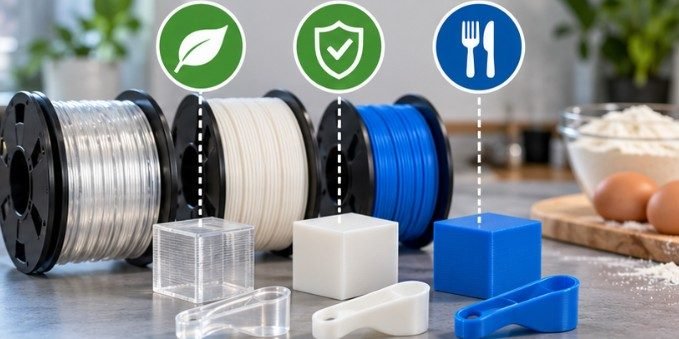
Even appropriate filament passes through hardware that may have been used with entirely different materials.
A printer that previously extruded carbon-fiber nylon, glow filament, ABS, experimental composites, or other materials can retain residue in the melt path. For food-contact projects, a dedicated printing setup is preferable.
Use a Dedicated Stainless-Steel Nozzle
Standard brass nozzles are inexpensive and print beautifully, but brass alloys can contain lead. For food-contact projects, a lead-free stainless-steel nozzle is the more conservative choice.
Ideally, dedicate that nozzle—and preferably the relevant hot-end components—to verified food-contact filament.
Avoid switching continuously between food-contact projects and abrasive, industrial, filled, or experimental materials.
Keep the Build Surface Clean
Glue sticks, hairspray, adhesives, dirty print beds, lubricants, and workshop debris can also contact the bottom surface of a print.
Use a clean build surface and avoid chemicals that are not intended for food-contact applications.
Should You Seal a 3D Print With Epoxy?
Applying a suitable coating can reduce the number of crevices exposed to food, but coating a print does not magically certify it as food-safe.
The coating itself must be appropriate for the intended type of food contact and must be mixed, applied, and cured according to the manufacturer’s instructions.
NSF/ANSI 51 establishes sanitation requirements for materials and finishes used in commercial food equipment, including coatings, sealants, gaskets, and other components.
A damaged coating is another concern. Scratches, chips, or delamination can expose the rough print underneath and create additional places for residue to accumulate. If a coated 3D print begins peeling, cracking, or becoming visibly scratched, stop using it for direct food contact.
A Practical Food-Contact Checklist
Before using a printed item around food, run it through this six-part test.
1. Verify the exact material
Look for manufacturer documentation tied to the specific filament SKU and color—not simply the underlying plastic family.
2. Define the food
Dry crackers, cookie dough, acidic tomato sauce, cooking oil, and boiling soup create completely different exposure conditions.
Temperature, fat content, acidity, and contact duration can affect chemical migration.
3. Examine the geometry
Avoid enclosed cavities, deep grooves, sharp internal corners, unnecessary seams, and areas where liquid can become trapped.
Using solid construction or high infill can also reduce the consequences of water entering through a damaged wall.
4. Assess cleanability
Penn State Extension recommends food-contact surfaces that are smooth, nonabsorbent, corrosion-resistant, well-drained, and easy to clean and sanitize.
5. Consider temperature
Do not assume a print is dishwasher-safe.
PLA in particular may soften or deform well below the temperatures tolerated by conventional kitchen utensils.
6. Choose low-risk uses
Short-duration contact is easier to manage than continuous food storage.
Cookie cutters, cake-decorating guides, dry-food scoops, fondant stamps, and temporary molds are generally more sensible DIY projects than reusable bottles, baby feeding products, cutting boards, or hot-drink containers.
Cleaning Does Not Fix a Poorly Designed Surface
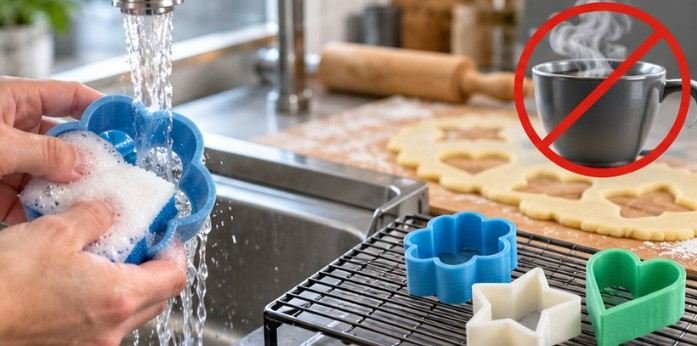
Sanitizing and cleaning are different processes. The University of Minnesota Extension recommends removing debris first, washing with detergent, rinsing, sanitizing, and finally allowing the surface to dry according to the sanitizer’s instructions. Sanitizers work properly only after food debris has been removed.
That presents a special challenge with 3D prints: bacteria or food residue buried inside inaccessible defects may not be removed effectively during the cleaning stage. A sanitizer cannot reliably compensate for a surface that cannot first be cleaned.
Common Misconceptions About Food-Safe Printing
One misconception is that 100% infill automatically makes a print food-safe. It does not. Solid infill can reduce internal voids, but it does nothing about filament chemistry, nozzle contamination, surface crevices, or unsuitable temperatures.
Another is that PLA must be safe because it can be produced from plant-derived feedstocks. Biological origin does not prove that every pigment, modifier, lubricant, or processing additive in the finished filament is suitable for food contact.
The same caution applies to resin printing. A part that feels hard after UV curing is not automatically suitable for food contact unless the resin and its curing process have been specifically validated for that purpose.
Frequently Asked Questions
1. Is PLA food-safe after 3D printing?
Not automatically. Some PLA formulations may use food-contact-compatible ingredients, but pigments, additives, printer contamination, surface roughness, temperature limits, and the intended application must also be evaluated.
2. Is PETG better than PLA for food-safe prints?
PETG usually offers better moisture and heat resistance, but the exact formulation must still be verified. Its printed layer lines can also create cleaning challenges.
3. Can I put a 3D-printed food item in the dishwasher?
Only if the material, coating, and finished object are specifically designed for those temperatures and detergents. Many PLA prints can soften or warp during dishwasher cycles.
4. Are 3D-printed cookie cutters safe?
They are among the more practical applications because contact is brief. Use documented food-contact material, clean printing hardware, simple geometry, and wash the cutter thoroughly after use.
Treat the Finished Object as the Product That Matters
The most useful rule is also the simplest: never judge food-contact safety by filament alone.
Good food safe 3d printing guidelines evaluate the complete system—the exact polymer formulation, nozzle, printer history, geometry, finish, coating, cleaning method, temperature, food type, and length of contact.
For occasional cookie cutters or decorating tools, careful home printing can be reasonable. For hot liquids, long-term food storage, commercial production, infant products, or heavily reused kitchenware, commercially manufactured and appropriately certified equipment remains the safer option. The spool may start the safety conversation, but the finished print has to pass the test.