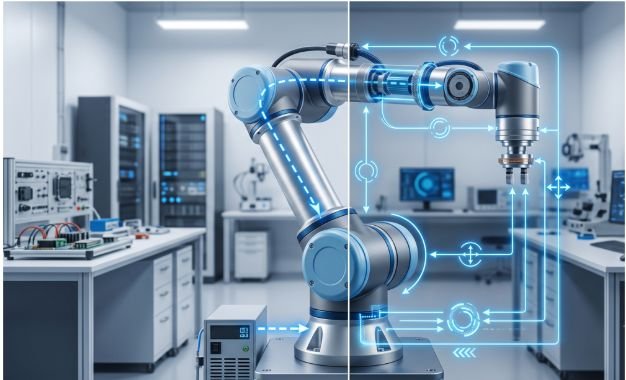
A robot can follow a command perfectly in software and still fail in the real world. The deciding factor is often feedback. In open loop vs closed loop robotics, an open-loop system acts without checking the result, while a closed-loop system measures the result and corrects errors.
When I compare both designs, I start with one question: must the robot know that the action actually happened? If yes, feedback usually becomes essential.
The Core Difference Between Open and Closed Loop Control
An open-loop controller sends a command to an actuator without measuring the final output. A closed-loop controller compares measured output with a target, calculates the error, and changes the command.
NIST describes a control loop as sensors, controller hardware, actuators, and communication between them. Measurements return to the controller, which interprets the signals and sends adjusted commands to the actuators.
That feedback path defines open loop vs closed loop robotics. This is the practical heart of open loop vs closed loop robotics. Open-loop control assumes the mechanism behaves as predicted. Closed-loop control checks that assumption during operation.
How Open-Loop Robotics Works
An open-loop robot may command motor voltage, movement time, pulse count, or step count. It never measures whether the wheel, shaft, or arm reached the requested state. Systems without feedback are classified as open-loop systems.
Imagine a stepper-driven arm receiving enough pulses for a 90-degree turn. If an obstruction stops it at 70 degrees, the program may still assume the full motion occurred.
Where Open-Loop Control Works Best
I consider open-loop control when the task is repetitive, loads remain stable, and small errors create no safety or quality risk. Basic conveyors, toys, timed dispensers, and simple indexing mechanisms may fit this pattern.
The advantages are clear: fewer components, lower cost, simpler wiring, and faster setup.
Where Open-Loop Control Fails
Open-loop systems cannot detect missed steps, wheel slip, mechanical drift, changing friction, weak batteries, or unexpected loads. The robot can therefore be wrong without knowing it.
A calibrated movement may work during testing but fail after the payload changes. This makes open-loop control risky when position, speed, or force must remain within strict limits.
How Closed-Loop Robotics Works

Closed-loop control adds observation. Encoders, cameras, force sensors, gyroscopes, current sensors, or limit switches measure the robot or its environment.
The controller compares the measurement with the target and reduces the difference through corrective commands. WPILib defines feedback control as using sensors to measure what a mechanism is doing, then moving it from its actual state toward the desired state.
Sensors, Error Signals, and Controllers
A position loop may work like this:
- The target is 90 degrees.
- An encoder reports 84 degrees.
- The controller calculates a 6-degree error.
- The motor receives another command.
- The loop repeats until the error falls within tolerance.
Encoders commonly measure shaft motion. PID controllers respond to current, accumulated, and changing error. WPILib provides both encoder interfaces and PID tools for robot mechanisms.
This is where sensors vs actuators in robotics matters. Sensors report what happened. Actuators create movement. The controller connects both sides.
Why Feedback Tuning Matters
Feedback does not guarantee good performance. Poor controller gains can cause overshoot, oscillation, sluggish motion, or instability.
I never treat “add an encoder” as the final step. Sensor direction, update speed, backlash, noise, timing, and gain values all affect the result. WPILib warns that reversed sensor and motion directions can make a feedback loop unstable.
Open Loop vs Closed Loop Robotics Comparison
The practical differences in open loop vs closed loop robotics are easier to see side by side.
| Factor | Open-loop robotics | Closed-loop robotics |
| Feedback | None | Continuous or periodic sensor feedback |
| Error correction | Cannot correct during operation | Corrects measured errors |
| Accuracy | Depends on predictable conditions | Maintains accuracy under many disturbances |
| Complexity | Lower | Higher |
| Cost | Usually lower | Usually higher |
| Setup | Faster | Requires tuning and validation |
| Disturbance response | Cannot detect changes | Can compensate for many changes |
| Best use | Stable, low-risk tasks | Precision, safety, and changing conditions |
Closed-loop cost includes more than the sensor. Designers must also account for calibration, signal filtering, controller software, fault handling, and testing.
Open Loop vs Closed Loop Robotics: A Worked Example

Consider a 300 mm robot arm that stops 1.5 degrees away from its target because the payload changed. At the tool tip, that small angle creates about 7.9 mm of lateral error:
300 mm × sin(1.5°) ≈ 7.9 mm
A toy may tolerate that error. Connector insertion, inspection, or precision dispensing may not.
I use this “failure budget” when judging open loop vs closed loop robotics:
- What is the maximum acceptable position, speed, or force error?
- Which disturbances could exceed that limit?
- Can the robot detect the error?
- Can it recover before causing damage or scrap?
When likely disturbance-driven error exceeds the acceptable limit, closed-loop control becomes the safer choice.
Why Hybrid Robot Control Often Wins
Real robots rarely sit at either extreme. Many combine feedforward commands with feedback correction.
A robot arm may estimate the motor effort needed for a planned move, then use encoder feedback to remove the remaining error. WPILib describes generated motion setpoints combined with PID tracking as an extremely common control strategy.
Some robots also use nested loops. An inner loop controls motor current, a middle loop controls speed, and an outer loop controls position.
Maxon documents dual-loop systems that use motor-shaft and output-shaft encoders to improve positioning when mechanical backlash or elasticity exists.
Hybrid control is not always a switch from rough open-loop motion to precise closed-loop motion. Feedforward and feedback often operate together. Feedforward provides fast predicted action, while feedback corrects errors that the model missed.
How to Choose the Right Control Method
For open loop vs closed loop robotics, choose open loop when errors remain harmless and operating conditions stay predictable. A sound open loop vs closed loop robotics decision begins with measurable tolerance.
Open-loop control may suit a mechanism with stable loads, repeatable motion, and no dangerous failure mode. It may also work when physical stops or mechanical constraints guarantee the final position.
Closed-loop control usually wins when:
- Payload or resistance changes
- People work near the robot
- Accuracy affects product quality
- Slip, backlash, or wear is likely
- The system must detect faults
- Recovery matters after interrupted movement
NIST’s closed-loop mobile manipulator work uses optical tracking feedback in a robotic manufacturing system. The same principle scales from a small encoder-controlled wheel to advanced industrial automation.
The correct choice depends less on how advanced the robot looks and more on what happens when reality differs from the command.
Frequently Asked Questions
1. What is the main difference in open loop vs closed loop robotics?
Open-loop robots do not verify their output, while closed-loop robots measure results and correct detected errors.
2. Is a stepper motor open loop or closed loop?
A standard stepper system often runs open loop, but an encoder and feedback controller can convert it into a closed-loop system.
3. Why is closed-loop control more accurate in robotics?
It measures actual performance and corrects deviations caused by load, friction, slip, wear, or environmental disturbances.
4. Can a robot use both open-loop and closed-loop control?
Yes. Many robots combine feedforward commands, motion profiles, and nested feedback loops for faster and more precise movement.
Pick the Loop Before the Robot Picks a Fight
The choice in open loop vs closed loop robotics is not about selecting the more advanced option by default. It is about matching control effort to failure risk.
I start with the acceptable error, then list every disturbance that could exceed it. If the robot must detect and correct those deviations, I close the loop. If the task stays predictable and failure remains harmless, open-loop control can be the cleaner design.