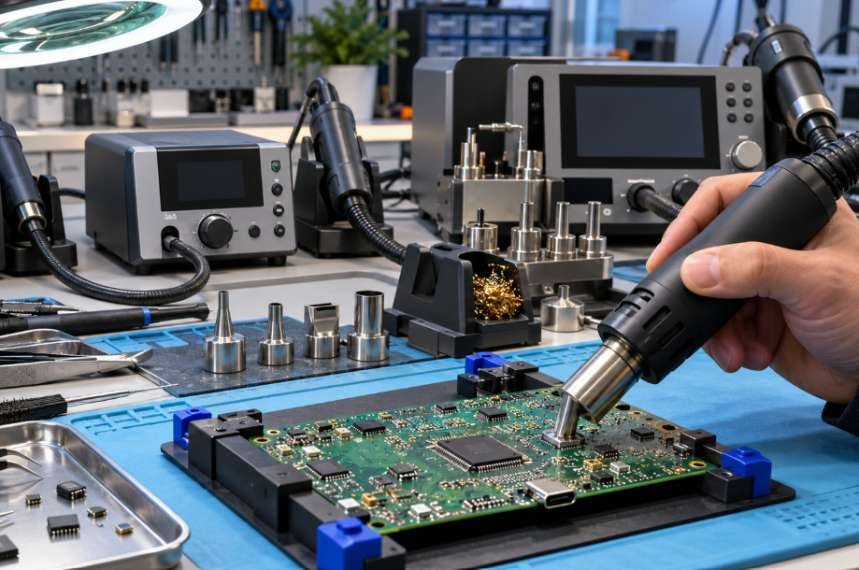
A tiny 0402 resistor, a stubborn USB-C connector, and a large QFN package may all need hot air, but they do not place the same demands on a rework station. That is where choosing the right tool gets more complicated than simply comparing wattage or maximum temperature.
In this hot air rework station comparison for surface-mount components, I focus on the differences that become obvious once real PCB work begins: how quickly a station recovers heat, how gently it can control airflow, how comfortable the handpiece feels, and how well it handles dense multilayer boards. I also compare popular options from YIHUA, ATTEN, Quick, and Hakko so US hobbyists and professional technicians can see which type of station fits their repair workload best.
Which Hot Air Rework Stations Are Best for SMD Repair?
Four names regularly stand out across the budget-to-professional range: YIHUA, ATTEN, Quick, and Hakko.
| Model | Category | Power | Airflow | Best Advantage | Main Trade-Off |
| YIHUA 858D | Budget/Hobbyist | 650W | Up to 120 L/min | Low cost and compact size | Less thermal headroom for demanding boards |
| ATTEN ST-862D | Entry Professional | 1000W | 30–120 L/min | Strong value and easy digital control | Larger bench footprint |
| Quick 861DW | Professional | 1000W | 1–120 adjustment levels | Fast heating and strong thermal recovery | Higher price than budget stations |
| Quick 861 Pro | Professional | 1300W | Up to 70 L/min | Higher power with refined control | Premium pricing |
| Hakko FR-810B | Premium | 820W at 120V | 5–115 L/min | Vacuum pickup and excellent build quality | More complex controls |
Quick lists the 861DW at 1000W with a 100°C to 500°C temperature range, three programmable channels, closed-loop temperature regulation, a brushless vortex fan, and automatic cooling. The newer 861 Pro increases power to 1300W and adds four-channel operation with a compact handpiece and stepless airflow adjustment.
Is the Quick 861DW or ATTEN ST-862D Better for Professional Repair?
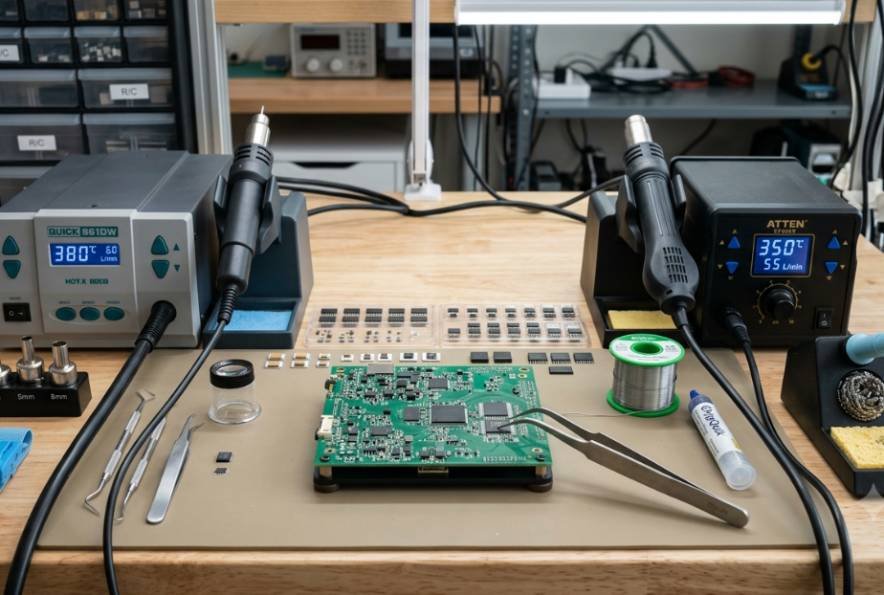
For busy US repair benches working on smartphones, laptops, consoles, QFN packages, and multilayer PCBs, I consider this the most interesting comparison.
The Quick 861DW has earned a strong reputation because of its rapid heat-up, closed-loop control, brushless vortex blower, programmable channels, and dependable recovery when a large ground plane pulls heat away from the target. That matters on dense lead-free boards where weak stations can force you to hold heat on the area for too long.
The ATTEN ST-862D is an aggressive value alternative. It is rated at 1000W, provides a 100°C to 480°C temperature range, and offers 30 to 120 L/min airflow. It also includes temperature calibration, standby operation, parameter locking, and an LCD interface. ATTEN documentation also highlights interchangeable straight and spiral airflow configurations.
If I were building a professional bench on a tighter budget, the ATTEN would be difficult to ignore. If maximum refinement, proven workflow, and thermal recovery were my priorities, I would lean toward the Quick.
Is the Hakko FR-810B Worth the Premium Price?
The Hakko FR-810B sits in a different category. For the US 120V version, Hakko rates the complete unit at 820W and airflow from 5 to 115 L/min. Its most distinctive feature is the integrated vacuum pickup system.
That pickup system allows the station to lift a component after the solder reaches reflow instead of forcing the operator to pull it mechanically. I like this approach because excessive lifting force can tear PCB lands or pads.
Hakko also designed the FR-810B for boards with high heat capacity and offers chain presets for basic thermal profiling. The trade-off is usability. Compared with the relatively direct controls found on Quick and ATTEN models, the Hakko interface can feel more menu-driven during fast bench work.
For production labs, enterprise repair environments, and technicians who prioritize durability and repeatability over price, however, it remains a serious option.
Are YIHUA 858D and 959D Stations Good Enough for Beginners?
For occasional DIY work, the YIHUA 858D represents the budget end of the market well. YIHUA lists the 858D at 650W, with a 100°C to 500°C operating range and maximum airflow of 120 L/min. It uses a brushless fan and PID-based temperature correction.
I would use this class of station for SOIC packages, SOT devices, simple charging ports, small connectors, and general hobby PCB repair.
Where it begins to struggle is on multilayer boards with large ground planes or heavy lead-free joints. Lower thermal reserve means the board can absorb heat faster than the station delivers it. The natural reaction is to increase temperature or dwell time, but that can raise the risk of damaging adjacent components or PCB laminate.
YIHUA and WEP-style combo stations such as the 995D+ or 862BD+ appeal to users who want both a soldering iron and hot air gun in a single compact unit. I see these as practical choices for general electronics technicians who only perform SMD rework occasionally and want to save bench space.
For electronics projects that involve wiring small components and connecting sensors, a reliable wire crimping tool for JST and Dupont connectors can help create secure connections for hobby circuits and DIY prototypes.
What Station Works Best for 0402, QFN, QFP, and BGA Components?
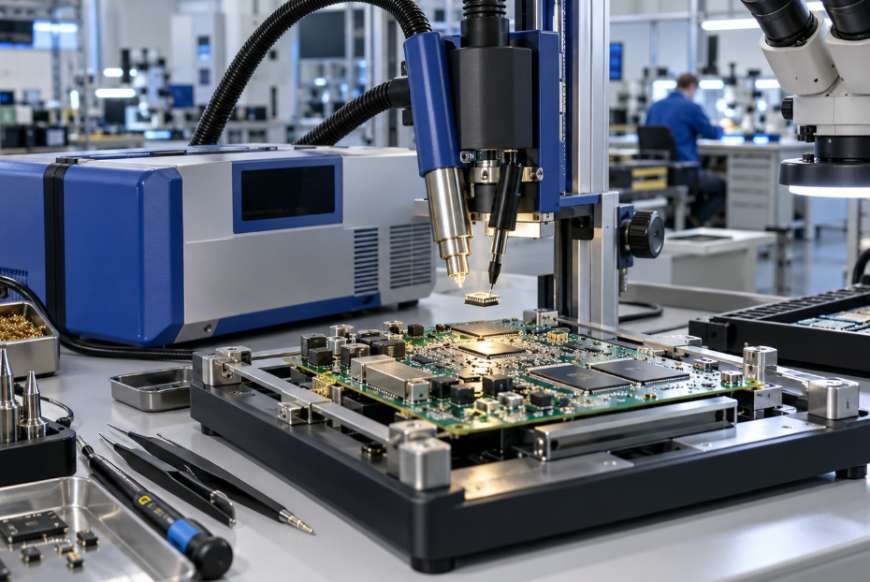
Component size changes what I value most.
For 0201, 0402, and 0603 passives, smooth, low airflow is more important than high wattage. Too much air can send a resistor across the PCB before the solder even melts.
For SOIC and SOT packages, a decent temperature-controlled hobby or mid-range station is usually enough.
For accurate measurements of small shafts, pins, grooves, and other precision components during electronics and mechanical projects, check out these best digital calipers for small mechanical parts to help choose a suitable measuring tool.
QFP packages benefit from even heating around all sides, while QFN packages demand stronger temperature stability because many solder joints and thermal pads sit underneath the component.
USB-C and HDMI connectors create another challenge. Their metal shells and ground connections can absorb significant heat, so strong thermal recovery becomes much more important.
BGA rework is where I would stop thinking about the hot air station alone. A high-power station can remove many BGAs, but a PCB preheater becomes increasingly valuable on thick multilayer boards.
Why Are Airflow and Thermal Recovery More Important Than Maximum Temperature?
A hot air station does not automatically become better because it reaches a higher temperature.
Thermal recovery tells me how well it maintains heat when the PCB starts absorbing energy. A 1000W or 1300W station with intelligent temperature regulation can recover faster than an inexpensive unit that loses nozzle temperature under load.
Airflow stability matters just as much. Fine SMD work needs a gentle, concentrated stream. Larger connectors and shielding cans may require significantly more airflow.
This is why advertised maximum airflow alone does not tell the whole story. I care about how smoothly the station lets me move from delicate 0402 work to high-mass connector removal.
Do I Need a PCB Preheater for Multilayer Boards?
For small boards, usually not. For high-thermal-mass PCBs, I often recommend one.
A preheater gradually raises the board temperature from below. That reduces the amount of concentrated heat required from the hot air nozzle and lowers thermal stress between the repair area and the surrounding PCB.
This becomes particularly useful for BGA packages, large QFNs, shielding cans, and connectors tied into major ground planes.
What Features Should I Pay Extra for in an SMD Rework Station?
I would prioritize accurate closed-loop temperature control, smooth airflow adjustment, useful nozzle choices, calibration capability, ESD-safe construction, automatic cooling, sleep mode, preset memory, and replaceable heaters.
I also pay attention to the handpiece itself. Budget stations often place the blower motor inside the wand, which keeps the base compact but can make the handle heavier. Higher-end systems may move more of the airflow hardware into the base station, producing a lighter handpiece and a different airflow feel.
For precision soldering tasks that require steady component positioning and a clearer view of small joints, a helping hands soldering station with magnifying glass can be a useful addition to your electronics workbench.
Ergonomics matter more than they appear to when you use the station every day.
Which Hot Air Rework Station Should You Buy?
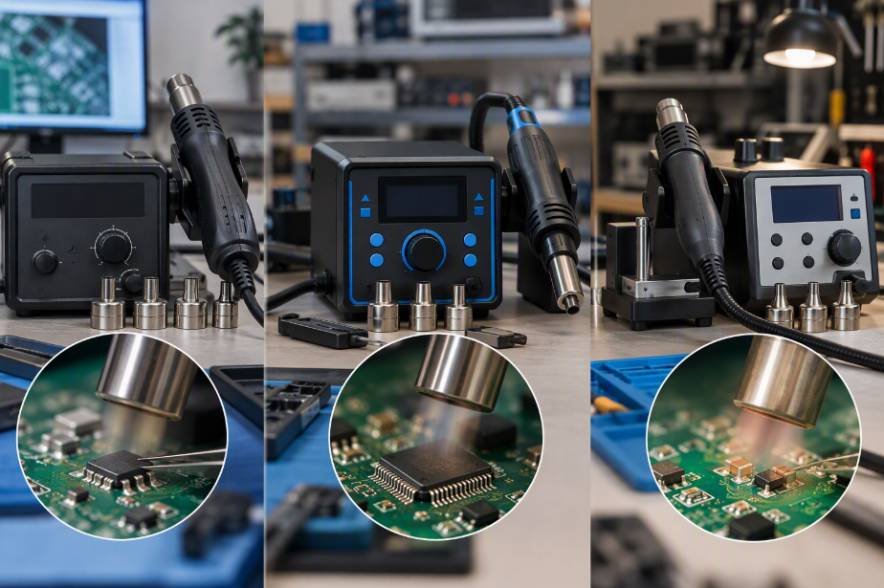
For occasional hobby repair, I would start with a YIHUA 858D-class station because it provides enough control for common SMD components without consuming much bench space.
For serious repair work, the ATTEN ST-862D offers an attractive balance between power and cost, while the Quick 861DW remains a strong professional benchmark. The Quick 861 Pro makes more sense when you want additional power and newer controls.
For premium laboratory or production work, the Hakko FR-810B delivers excellent construction, broad airflow capability, and its useful vacuum pickup system.
Ultimately, the best hot air rework station comparison for surface mount components should not end with one universal winner. The correct station depends on whether you repair tiny passives, QFN devices, charging ports, multilayer PCBs, or large BGA packages.
Frequently Asked Questions
1. Is a 700W hot air station enough for SMD repair?
Yes, for many basic repairs. It can handle SOIC packages, smaller ICs, passives, and light connector work. High-thermal-mass multilayer PCBs may benefit from a 1000W-class station or preheating.
2. What airflow should I use for 0402 components?
Use the lowest airflow that still transfers enough heat to reach reflow efficiently. Gentle airflow reduces the chance of moving nearby tiny components.
3. Is Quick 861DW better than ATTEN ST-862D?
Both target serious repair work. Quick emphasizes closed-loop control, programmable channels, rapid heating, and a vortex fan, while ATTEN provides 1000W power, broad airflow adjustment, calibration, and strong value.
4. Do I need hot air for QFN rework?
Hot air is one of the most practical methods because QFN solder joints sit beneath the package. Stable temperature, controlled airflow, flux, and sometimes preheating make the process much safer.
5. What is the best hot air rework station comparison for surface-mount components for a repair shop?
For a professional shop, I would compare the ATTEN ST-862D, Quick 861DW or 861 Pro, and Hakko FR-810B based on workload, thermal recovery, airflow control, ergonomics, spare-part availability, and budget.
Final Takeaway
When I evaluate an SMD rework station, I do not chase the largest wattage number by itself. I look at how effectively that power becomes stable, controllable heat at the board.
For tiny SMD components, airflow finesse wins. For USB-C connectors and multilayer boards, thermal recovery becomes critical. For BGA work, preheating and overall process control matter even more.
That is why a budget YIHUA can make sense for occasional repairs, an ATTEN can be excellent value for a growing shop, Quick can justify its place on a busy professional bench, and Hakko can make sense where reliability and controlled component handling matter more than upfront cost.