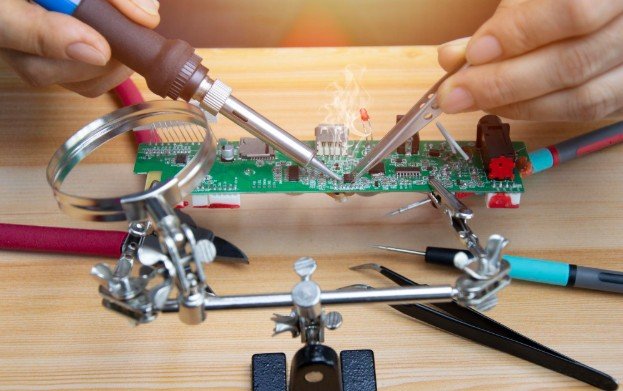
I find few workshop frustrations more distracting than a tiny connector moving just as everything lines up. A useful vise should make that moment easier without covering solder pads or squeezing a delicate board.
When choosing the best mini bench vise for circuit board and small parts assembly, I prioritize controlled grip, convenient positioning, and a base that suits the workspace. This guide compares four options using published specifications rather than claiming hands-on testing.
Which Mini Vise Should You Choose?
For mixed tasks involving small boards, switches, and connectors, the PanaVise 201 Junior is my strongest starting recommendation. Its compact jaws and adjustable head address several assembly jobs.
Choose Stickvise when keeping a circuit board flat matters most. Consider the Proxxon FMS 75 for mixed hobby assembly on a suitable smooth surface. The Hakko Omnivise deserves attention when level board support and documented ESD protection take priority over an articulating head.
Four Options Worth Comparing
PanaVise 201 Junior: Best Starting Point for Mixed Assembly
The PanaVise 201 has grooved, reinforced composite jaws opening to 73 mm, or 2.875 inches. That capacity suits many small modules and loose components, provided their shape leaves enough accessible gripping area.
Its adjustable head helps present the work at a comfortable angle. This matters when alternating between soldering a connector and inspecting its underside.
The main limitation is capacity. Measure the dimension you intend to clamp, including protruding connectors. When reading a helping hands soldering station with magnifying glass review, distinguish the included vise base from optional mounting accessories so you can compare packages accurately.
Stickvise: Best for Flat Circuit Board Work
Stickvise holds boards near the tabletop, making it appealing for fine soldering and microscope work. Its standard configuration provides a maximum opening of approximately 155 mm and insulating Nylon 6/6 jaw plates.
Clearance deserves particular attention. Standard clearance above the shaft is approximately 7.4 mm, so underside components can interfere even when the board fits between the jaws.
This is a specialized board holder rather than a universal small parts vise. Choose it for accessible PCB edges and low working height, rather than expecting it to grip every irregular connector.
Proxxon FMS 75: Best for Smooth-Surface Hobby Assembly
The Proxxon FMS 75 combines a suction base, an adjustable ball joint, and protective jaw covers. Its jaws measure 75 mm wide, with a maximum clamping opening of 70 mm.
That arrangement makes it worth considering for small housings, brackets, and mixed assembly tasks alongside electronics.
The mounting surface determines its usefulness. Suction requires a flat, smooth surface, so check your bench before purchasing. Protective covers also do not guarantee that every delicate board can tolerate the pressure applied.
Hakko Omnivise: Best for Level Board Support
The Hakko C1390C Omnivise is a weighted support designed to hold work horizontally. It offers five height settings, padded jaws, an opening adjustable to 20 mm, and documented ESD protection.
That 20 mm specification describes the gripping opening, not maximum board width. Larger assemblies may require two or more supports.
Choose this design when keeping a populated board level is the priority. It serves a different purpose from a ball-joint vise that tilts the work toward you.
Features That Matter Before Buying
Jaw Fit and Component Clearance
Maximum opening tells only part of the story. Check jaw depth, groove placement, and whether the jaws obstruct nearby components.
A board can fit across its width yet remain awkward to solder because the clamp covers an edge connector. Small mechanical parts create another challenge: curved surfaces may need appropriate jaw inserts.
Base Stability and Adjustment Speed
Match the mounting system to your workspace. A permanent mount suits a dedicated bench, while a portable base makes storage easier. A suction base depends on surface compatibility.
Adjustment speed matters during repetitive assembly. Consider how often you change parts and whether repositioning requires several separate controls.
Heat Limits and ESD Properties
Insulating jaws and static-dissipative jaws have different properties. Check documented ESD suitability rather than assuming plastic automatically protects sensitive electronics.
Published jaw temperature ratings also do not authorize direct contact with a soldering tip. Keep hot tools clear and verify compatibility before using hot air near protective covers.
Mini Vise, PCB Frame, or Helping Hands?
A mini vise suits jobs requiring a compact, adjustable grip on boards or loose parts. A PCB frame is worth considering for repeated through-hole assembly and convenient board flipping.
Helping hands are useful when a wire needs separate support beside the main workpiece. Select the tool around your usual task rather than the number of included accessories.
Frequently Asked Questions
1. What is the best mini bench vise for circuit board and small parts assembly?
The PanaVise 201 Junior is a sensible starting choice for mixed small-part work. A dedicated flat holder may suit board-focused soldering better.
2. Can a mini vise damage a circuit board?
Yes. Excessive pressure, unsuitable jaws, or contact with components can cause damage. Grip an appropriate clear edge and tighten gently.
3. Should I choose a suction base?
Choose one when your work surface is smooth, flat, and compatible with the mounting instructions. Check its hold before starting.
My Final Take
I would start by measuring the parts I handle most often, then choose the simplest holder that supports them comfortably. For varied small assemblies, I favor an adjustable mini vise; for board-only work, a dedicated holder can offer better access. A useful purchase solves your recurring holding problem without creating another one.