A robot can move without a nearby person yet still lack autonomy. The real question is who decides what happens next. When I compare autonomous vs teleoperated robots, I examine decision authority, connection needs, and failure recovery—not appearance.
Autonomous systems sense, plan, and act within defined limits. Teleoperated systems keep a person in the control loop. Many practical robots combine both approaches.
Autonomous vs Teleoperated Robots in One Sentence
NIST defines a fully autonomous system as one that completes an assigned mission within a defined scope without human intervention. Teleoperation uses off-board human control and sensory feedback through direct commands or frequent incremental goals.
What Is an Autonomous Robot?
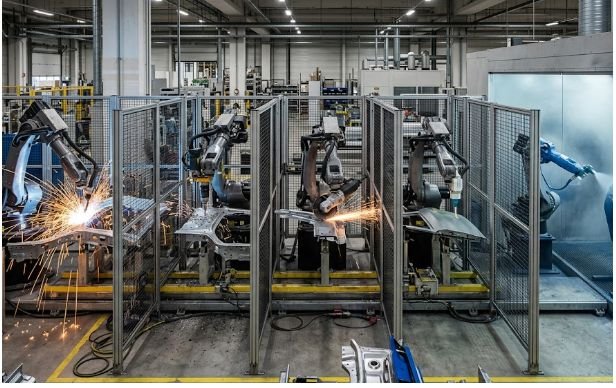
An autonomous robot uses sensors, software, and onboard controls to choose actions without continuous human input. Cameras, lidar, radar, GPS, encoders, and force sensors may feed its perception system.
The software interprets that data, estimates surrounding conditions, plans an action, moves, and checks the result. This creates a continuous feedback loop rather than a fixed sequence of blind commands.
Autonomy always has boundaries. A warehouse robot may navigate mapped aisles alone but stop when an unfamiliar obstacle blocks its route. “Autonomous” means independent inside an approved operating domain. It does not mean prepared for every possible event.
What Is a Teleoperated Robot?
A teleoperated robot follows ongoing commands from a remote human operator. The operator may use joysticks, pedals, touchscreens, haptic controls, virtual-reality equipment, or a computer dashboard.
Video, audio, depth information, and force feedback reveal what is happening around the machine. The quality of that feedback directly affects the operator’s judgment.
The robot may still stabilize itself, limit force, maintain balance, or avoid collisions. Those local safeguards support the operator but do not make the entire task autonomous.
Autonomous vs Teleoperated Robots: Key Differences
The core difference is where judgment lives. That makes autonomous vs teleoperated robots a question of control responsibility, not hardware style.
| Factor | Autonomous Robot | Teleoperated Robot |
| Main controller | Onboard software | Remote human operator |
| Human role | Supervision or exception handling | Continuous guidance |
| Connectivity | Can often continue locally | Usually needs a stable link |
| Novel situations | Limited by models and rules | Benefits from human interpretation |
| Scalability | Can support fleet supervision | Consumes more operator time |
| Best environment | Structured and repeatable | Hazardous or unpredictable |
| Main risk | Incorrect machine decision | Lag, poor visibility, or human error |
| Typical examples | Warehouse AMRs and robot vacuums | Surgical and bomb-disposal systems |
Autonomous systems usually offer better scalability because people do not need to control every movement. Teleoperation offers greater flexibility when the environment becomes difficult to interpret.
How Autonomous Robots Decide
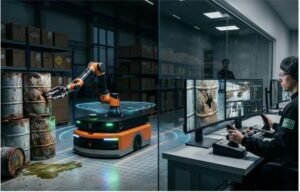
Most autonomous robots run a closed loop: sense, interpret, plan, act, and verify. A mobile robot may detect an obstacle, estimate its position, calculate a route, command its motors, and correct drift while moving.
Waymo’s driving system provides a familiar example of the sensing layer. Its official documentation describes lidar, cameras, and radar working together to observe the vehicle’s surroundings. The broader lesson is that autonomy needs enough reliable data for its intended operating environment.
More sensors do not automatically create better autonomy. Developers must calibrate them, combine conflicting readings, test environmental limits, and define safe responses to uncertainty.
Capability claims also require testing. NIST develops performance metrics and standard test methods for autonomous mobile robots because the word “autonomous” alone does not prove reliability, safety, or task performance.
How Teleoperated Robots Extend Human Reach
Teleoperation separates the worker from danger while preserving human judgment. That combination suits unstable, delicate, or rapidly changing tasks.
Computer-assisted surgical systems show the distinction clearly. The FDA explains that these systems do not perform surgery independently. A surgeon controls the instruments from a console while viewing the surgical area through an imaging system.
Teleoperation also appears in mining, disaster response, deep-sea inspection, hazardous-material handling, and explosive-ordnance disposal. NIOSH research describes remote machinery that keeps operators in safer locations while equipment works in hazardous areas.
The communication chain becomes the critical weakness. Lag, dropped video, narrow camera views, or poor depth cues can reduce situation awareness.
A strong teleoperated system therefore needs safe-stop behavior, link monitoring, secure access, multiple camera views, and an interface that limits operator overload.
Shared Autonomy Blurs the Line
The autonomous vs teleoperated robots comparison is rarely a strict either-or decision. Shared autonomy divides control between the person and the machine.
A person may choose the destination while the robot handles route planning and obstacle avoidance. In manipulation tasks, the operator may select an object while the robot calculates a safe arm trajectory.
NASA JPL has developed architectures that combine supervised human input with semi-autonomous mobile manipulation. Mars rover operations have also mixed planned human commands with onboard navigation functions.
I use a simple decision-rights rule:
Give software the decisions it can make quickly, repeatedly, and verifiably. Keep people responsible for ambiguous, delicate, ethical, or high-consequence choices.
That division avoids two common mistakes. The first is forcing an operator to micromanage every motor. The second is granting software more responsibility than testing can justify.
Worked Example: One Robot, Three Control Modes
Imagine a mobile manipulator entering a US warehouse after a chemical spill.
In autonomous mode, it maps an aisle, avoids debris, recognizes approved containers, and transports them to a safe zone. This approach works when objects, labels, and handling procedures remain standardized.
In teleoperated mode, a hazardous-material specialist studies live video and manually opens a damaged cabinet. Human judgment helps because labels are hidden and containers have shifted.
In shared-autonomy mode, the operator selects the cabinet handle. The robot plans the arm path, limits gripping force, avoids nearby objects, and stops if the communication link fails.
The robot’s body may remain identical in all three cases. Decision ownership changes.
That is the most useful insight I apply when evaluating autonomous vs teleoperated robots: choose the control architecture before buying impressive hardware.
How to Choose Between Autonomous Vs Teleoperated Robots
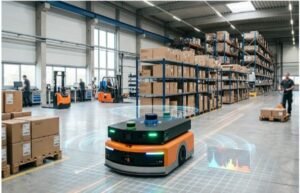
For teams comparing autonomous vs teleoperated robots, the right choice depends on task structure, uncertainty, and the cost of failure.
Choose Autonomy for Repeatable Scale
Favor autonomy when the environment is structured, tasks repeat frequently, and outcomes can be measured. Warehouses, inspection routes, floor cleaning, agricultural monitoring, and routine material movement often fit this model.
Ask whether the robot can detect when it has moved beyond its competence. A safe system should pause, request assistance, or enter a controlled fallback rather than guess.
Businesses should also consider mapping requirements, sensor maintenance, software validation, integration costs, and the time needed to test unusual situations.
Choose Teleoperation for Uncertainty
Favor teleoperation when human interpretation matters more than fleet scale. Disaster response, surgery, subsea inspection, delicate manipulation, and explosive-ordnance work may require a person in the loop.
Evaluate network coverage, latency, camera placement, cybersecurity, operator workload, training requirements, and emergency-stop design.
Continuous teleoperation also creates labor costs. A robot that needs constant control may relocate work rather than eliminate it.
Choose Shared Autonomy for Mixed Work
Shared control fits tasks that combine routine movement with unpredictable decisions. The robot handles low-level motion while the operator manages intent and exceptions.
This design can improve scalability when one person supervises normal autonomous operation and intervenes after a help request. It should not be confused with manually driving several machines at once.
Shared autonomy also provides a practical deployment path. Teams can begin with human control, collect operational data, and automate well-understood parts gradually.
End Effectors Still Decide What the Robot Can Do
In autonomous vs teleoperated robots, good control cannot compensate for the wrong physical tool. Compare the types of robot end effectors with payload, reach, gripping force, sensing, material properties, and task requirements.
Autonomy determines who selects and plans an action. The end effector determines how the robot grips, cuts, welds, suctions, dispenses, or measures.
A teleoperator cannot securely lift a glass container with an unsuitable gripper. Autonomous software cannot solve that mechanical mismatch either.
Pick the Brain Before You Buy the Body
The autonomous vs teleoperated robots debate becomes simpler when I trace every important decision. Who sets the goal? Who plans the motion? Who detects failure? Who takes over when conditions change?
Use autonomy for repeatable work with testable boundaries. Use teleoperation when remote human judgment protects safety or quality. Use shared autonomy when software can manage motion but people must handle uncertainty.
Before selecting a platform, map one complete task from detection through recovery. The gaps in that map will reveal the right control model faster than a polished demonstration.
Frequently Asked Questions
1. Which Is Better: Autonomous Vs Teleoperated Robots?
Neither is universally better; autonomy favors repeatable scale, while teleoperation favors human judgment in uncertain situations.
2. Are Teleoperated Robots Autonomous?
Not necessarily. Automatic safety functions may assist the human, but the operator still directs the main task.
3. What Is the Difference Between Autonomous and Remote-Controlled Robots?
Autonomous robots choose actions within defined limits, while remote-controlled robots depend on continuous human commands.
4. Can Autonomous Robots Work Without the Internet?
Yes. Many process sensor data locally, although cloud services may support updates, analytics, and fleet management.