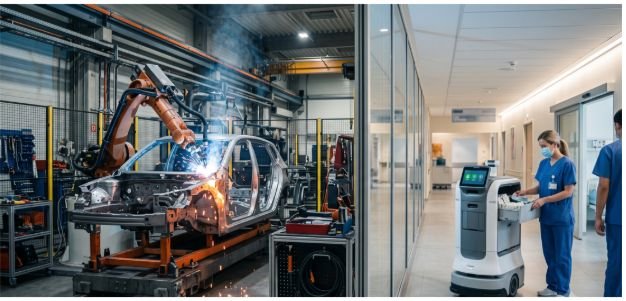
A factory arm welding car frames and a hospital robot delivering supplies may look equally advanced, but they solve different problems. The clearest way to compare industrial vs service robots is to examine the task, environment, safety model, and level of human interaction.
That four-part test prevents a common mistake: classifying robots by appearance instead of application.
Industrial vs Service Robots: The Quick Answer
Industrial robots automate manufacturing. They usually work where parts, tools, and movements remain predictable. Common jobs include welding, painting, assembly, palletizing, packaging, and machine tending.
Service robots perform useful tasks outside traditional production, from home cleaning to hospital delivery and surgery.
The main industrial vs service robots differences are:
- Purpose: Production versus assistance.
- Environment: Controlled workcells versus changing human spaces.
- Safety: Guarded operation versus close-contact awareness.
- Mobility: Often fixed versus frequently mobile.
- Performance: Repeatability versus adaptability.
The International Federation of Robotics uses ISO-based definitions. An industrial robot is an automatically controlled, reprogrammable, multipurpose manipulator programmable in at least three axes. A service robot performs useful tasks for humans or equipment in personal or professional use.
What Makes an Industrial Robot Industrial?
Production Defines the Category
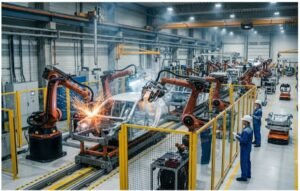
Industrial robots center on repeatable production. Engineers reduce process variation so an arm, palletizer, or picker can repeat a path efficiently.
The sector is widely deployed. IFR reported 542,000 industrial robot installations worldwide in 2024, the fourth straight year above 500,000 units.
Common formats include articulated, SCARA, delta, Cartesian, and collaborative robots.
Control, Precision, and Safety
Industrial systems often connect with programmable logic controllers, machine vision, conveyors, and safety controllers. Engineers optimize cycle time, payload, tooling, and repeatability.
Traditional factory robots may move heavy tools at high speed. Facilities therefore use fences, interlocked doors, scanners, light curtains, and emergency stops. OSHA notes that many robot accidents occur during setup, maintenance, programming, testing, or adjustment.
OSHA currently has no single robotics-specific standard. Employers must apply relevant guarding, electrical, lockout, and general safety rules.
What Counts as a Service Robot?
Professional Service Robots
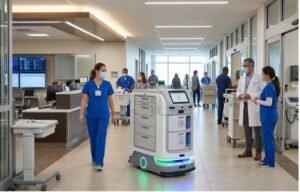
Professional service robots work in commercial or public settings, including hospitals, warehouses, farms, and inspection sites.
These machines face more variation. A delivery robot may encounter people, carts, open doors, and temporary obstacles. It needs localization, obstacle detection, route planning, and safe stopping.
NIST research identifies human detection, trust, situation awareness, and interface performance as major human-robot interaction concerns.
Personal Service Robots
Personal service robots include vacuums, pool cleaners, lawnmowers, companion devices, and mobility aids.
They often trade factory-grade precision for affordability and flexibility. A vacuum does not need sub-millimeter placement. It must cover a room, avoid stairs, handle clutter, and return to its charger.
Industrial vs Service Robots: Where Differences Matter
Structured Versus Unstructured Environments
A structured environment controls variables. Parts arrive in known positions. Fixtures hold materials consistently. People follow access rules.
Unstructured spaces change as people move, doors close, and obstacles appear. Service robots must respond without constant reprogramming.
This industrial vs service robots distinction explains why service machines often need broader perception. Their surroundings provide fewer guarantees.
Precision Versus Adaptability
Industrial robots usually lead in repeatability, payload, speed, and duty cycle. Service robots often lead in navigation, contextual response, and flexible task handling.
Neither category is universally better. In an industrial vs service robots comparison, success depends on task fit. A welding cell gains little from roaming. A hospital courier does not need welding-level path accuracy.
Separation Versus Human Proximity
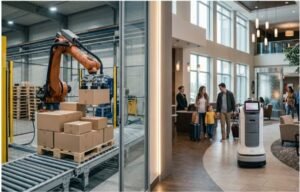
Many industrial cells keep people outside the operating zone. Many service robots share space with users. That proximity changes sensing, braking, interface design, and risk assessment.
Collaborative robots blur the visual boundary. A cobot remains an industrial robot when it performs manufacturing work. Collaborative features describe interaction, not a switch into service robotics.
Autonomy Does Not Decide the Category
A common industrial vs service robots mistake is treating autonomy as the deciding factor. Either category can be autonomous, supervised, manually guided, or remotely operated.
The separate comparison of autonomous vs teleoperated robots explains who makes operational decisions. It does not define the application category.
Robot-assisted surgical systems prove the point. The FDA explains that surgeons control these instruments through computer and software technology. They are service robots, yet a clinician remains in control.
Location can also mislead. A mobile robot may transport parts inside a factory, but classification still depends on its application and technical characteristics.
A Worked Industrial vs Service Robots Example
Consider two jobs inside one distribution center.
The first stacks identical cartons from a fixed conveyor. I would select an industrial palletizer because speed, payload, and repeatability drive the result.
The second moves mixed supplies through changing aisles. I would select a professional service robot because navigation and safe coexistence matter more than fixed-path precision.
The lesson is simple: classify the task before classifying the machine.
How to Choose the Right Robot
I use three questions. Does the robot directly support manufacturing? Can the process become a predictable workcell? Must the robot navigate around people during normal work?
More “yes” answers to the first two questions favor industrial automation. A strong “yes” to the third favors service robotics or a carefully designed collaborative system.
For buyers, total deployment cost also matters. Hardware is only one part. Integration, guarding, mapping, software, facility changes, maintenance, training, cybersecurity, and support can reshape the business case.
Frequently Asked Questions
1. What is the main difference between industrial and service robots?
Industrial robots automate production, while service robots assist people or equipment with useful non-manufacturing tasks.
2. Are collaborative robots industrial or service robots?
Cobots are industrial robots when they perform manufacturing tasks, even if they work near people.
3. Are all service robots autonomous?
No. They may be autonomous, supervised, remotely operated, or directly controlled by a professional.
4. Which costs more in an industrial vs service robots comparison?
Either can cost more because payload, sensors, software, integration, safety, and regulatory needs determine the final price.
Pick the Job, Not the Robot Hype
The smartest industrial vs service robots decision starts with the workflow, not the hardware brochure. Define the task, map the environment, identify human contact, and set measurable performance goals.
I would choose an industrial robot for stable, repetitive production. I would choose a service robot when movement, adaptation, or human assistance defines success. Start with the job, then buy the machine that fits it.